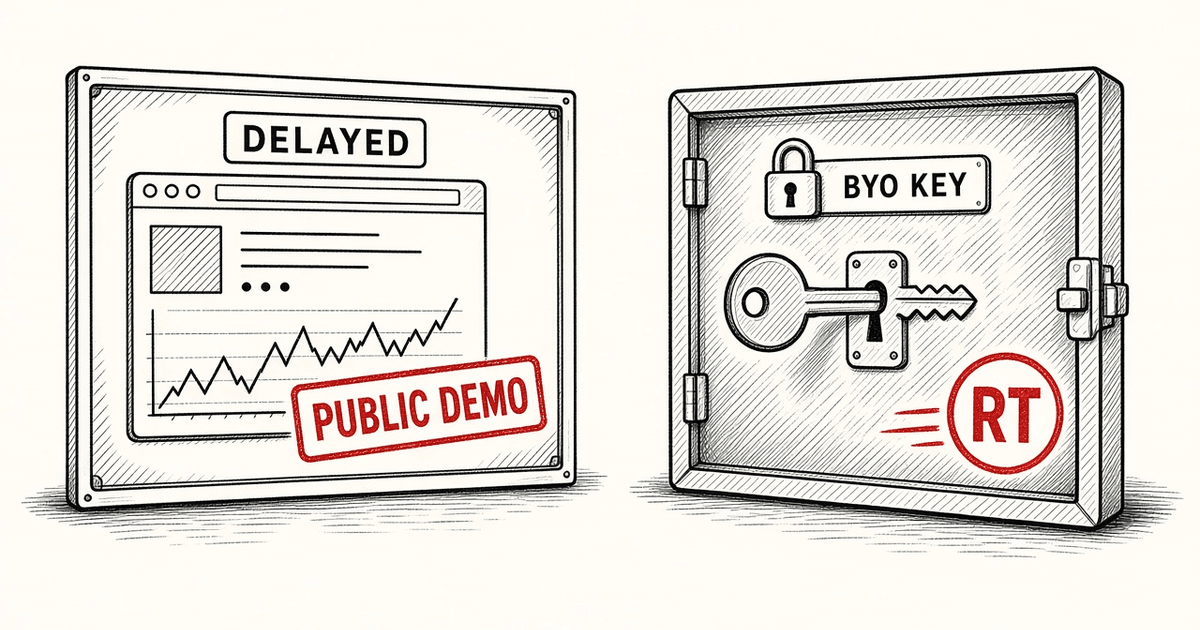
The public Demo and the private install share Desk OS language - command field, linked panels, citation chips - but they run on different clocks and contracts. The two states to keep apart are Demo delayed literacy (public sources, locked private features, acquisition board) and private real-time (BYO) (customer keys, optional broker read-only, local residency). When the path works, you never narrate Demo as entitled RT, and you never narrate private RT as "RomeWay SIP." The look-alike to refuse is collapsing both into one product story or calling either a Bloomberg alternative.
Sibling jobs: packaging pillar private on-prem, keys BYO market data keys, holdings broker read-only, public vs licensed framing public market data vs terminal data, board intro web research terminal, citations cited numbers, morning pass morning routine, live Demo terminal, learn delayed quote.
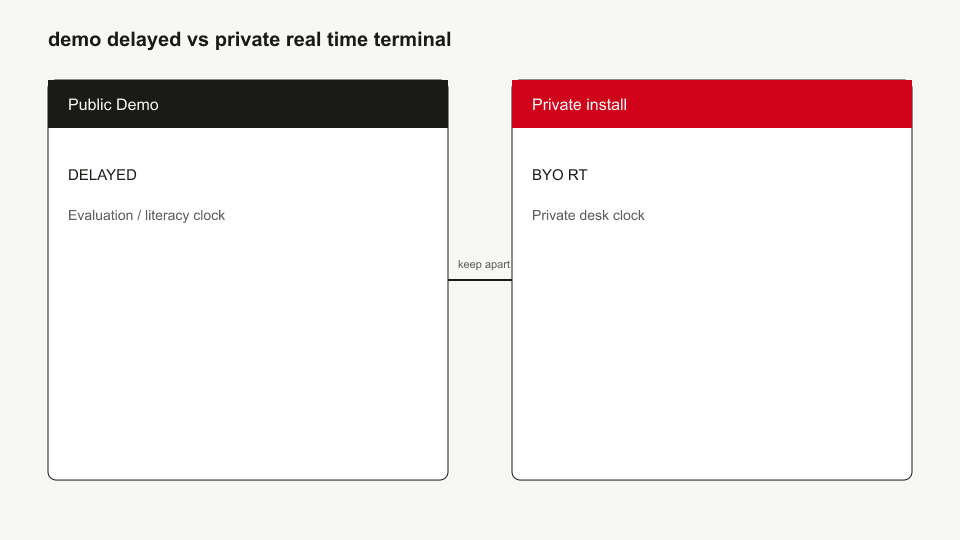
- Evaluation week: Demo only - practice morning routine on delayed tape.
- Install week: private stack + BYO keys - badges may become RT per contract.
- After confusion stops: two URLs, two contracts, one refuse list (no targets).
Who this page is for
Anyone comparing the public board at romewayai.com with a paid single-tenant install and needing a crisp Demo vs private matrix.
Takeaway: Same chrome - same clock.
Who should skip
Skip if you only need delayed-quote vocabulary - learn page. Skip if you need filing mechanics. Skip if you want order entry - neither edition trades.
Takeaway: Leave for glossary-only, filings, or execution.
Out of scope
No vendor fee tables, no SLA guarantees, no Bloomberg cosplay, no buy/sell. "Real-time" here means whatever the customer's entitled feed returns - including delayed SIP if that is all they bought.
Takeaway: RT is a badge, not a slogan.
Clock: evaluate - install - badge check
- Open Demo; complete a morning pass on delayed quotes.
- Note locked surfaces (holdings, full model hub, supervisory export).
- If residency and BYO matter, move to private packaging.
- After keys: confirm badge text before any "we are live" sentence.
Takeaway: Badge check is the last gate before live language.
Side-by-side matrix
| Dimension | Public Demo | Private install |
|---|---|---|
| Quote clock | Delayed public | Per BYO contract (RT or delayed) |
| Who entitles data | Demo public path | Customer - vendor |
| Holdings | Example universe | Read-only broker / CSV |
| AI drafting export | Literacy / locked | Supervisory queue available |
| Residency default | Hosted Demo | Customer machine / private cloud |
| Commercial | Acquisition | One deployment packaging |
Takeaway: Read the row before you pitch the column.
Look-alike matrix
| Confused pair | Keep separate |
|---|---|
| Demo vs private | Literacy board vs single-tenant desk |
| Delayed vs RT badge | Public path vs entitled feed |
| Charting app vs Desk OS | Draw tools vs cited multi-panel research |
| Private RT vs data resale | Customer key vs RomeWay-sold SIP |
Takeaway: Private does not mean we sold you the tape.
Common mistakes
- Recording a Demo walkthrough and calling it private RT.
- Wiring production broker tokens into a shared Demo browser.
- Promising SIP because the private brochure said "real-time."
- Skipping citation rules because the UI looks denser.
Takeaway: Density is not entitlement.
FAQ
Is the Demo free forever?
It is the public acquisition board with delayed public data - not the private product.
Does private always show RT?
Only if your key's contract returns RT. Otherwise the badge stays honest.
Do both editions refuse targets?
Yes. Model bands and notes still follow bands - targets and supervisory rules when export exists.
Where do I start?
Open the Demo, then read private on-prem if you need residency.
What to do next
- Keys: BYO market data keys.
- Holdings: broker read-only.
- Client notes: supervisory queue.