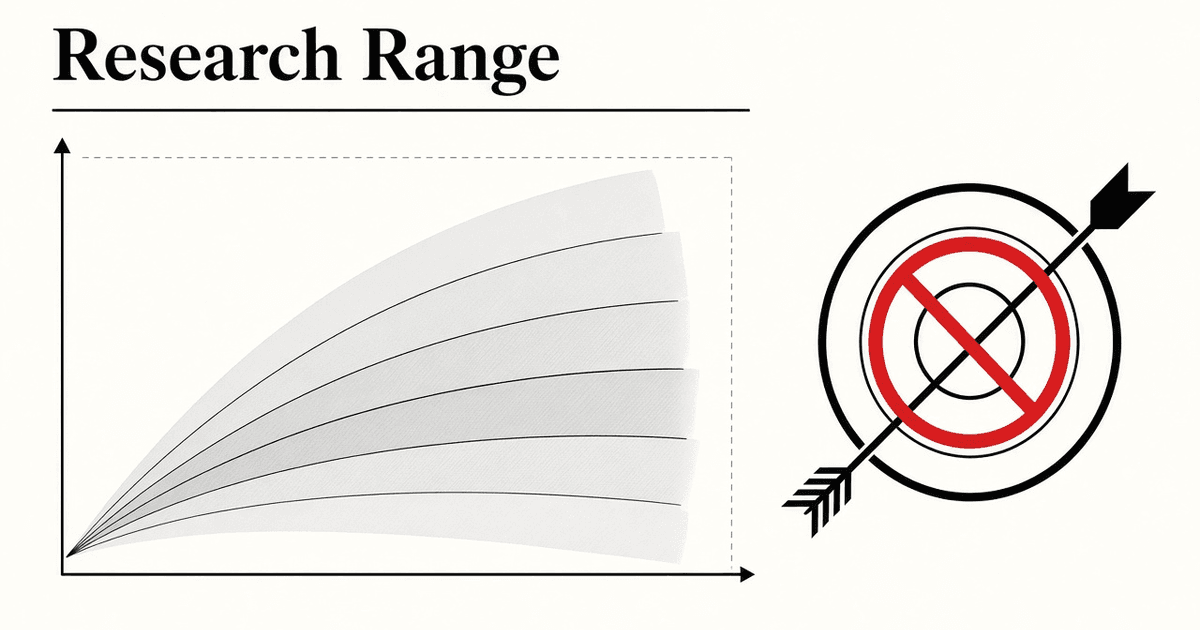
A model scenario band is a research range - for example a fan of possible next K-line paths or a volatility interval - drawn as a desk object with a model card, an as-of, and (when wired) a sample-out scoreboard. The two states to keep apart are scenario geometry (what the model drew under stated assumptions) and price target language (an advisory or sell-side objective someone might put in a note). When the path works, you can say which model version produced the band and what you still refuse to say. The look-alike to refuse is reading the band midpoint - or any single path - as "the target."
Sibling jobs: citation hygiene in cited market numbers, board mechanics in web research terminal, private model hub framing in private on-prem, client refuse script in explaining AI themes without targets, Demo terminal, learn citation chip.
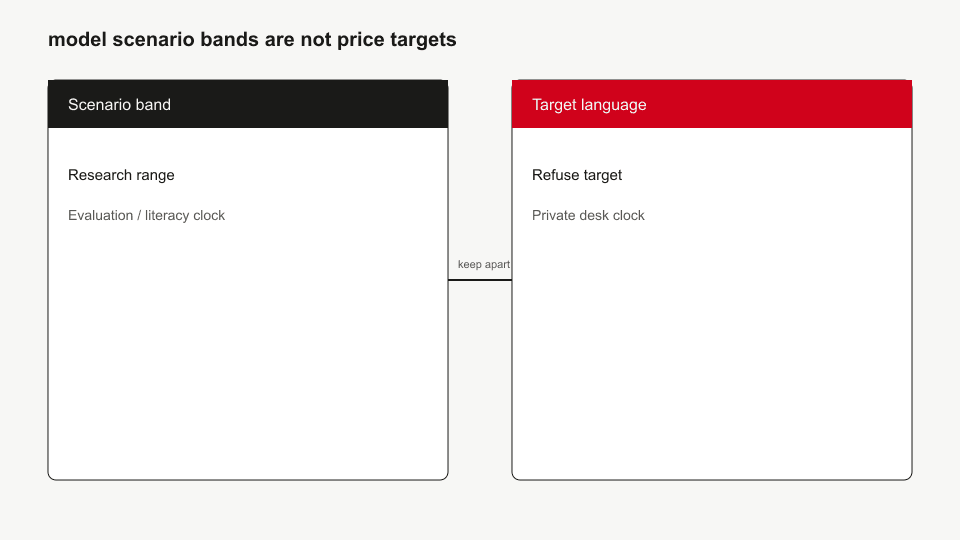
- While the band renders: name model, version, and horizon.
- When someone asks "so what's the target": switch clocks - refuse; point to process elsewhere.
- After evaluation night: show sample-out coverage vs a baseline label - never invent a live score in this article.
Who this page is for
Desk users who will see FCST-style panels, FinBERT tape scores, or rule signals and must keep research objects separate from advice language.
Takeaway: Geometry - objective.
Who should skip
Skip if you came for a target or a buy list. Skip if you need filing math - start at where AI demand shows up. Skip if you need supervisory export - supervisory queue.
Takeaway: Leave for targets, filings, or approval workflows.
Out of scope
No published RankIC, MAE, or hit-rate numbers on this URL. No "will outperform." No order entry. Hypothetical performance stays internal when Quant Lab exists - not for client PDFs.
Takeaway: Vocabulary and refuse rules only.
Clock: draw, label, evaluate, refuse
- Model hub draws a band from entitled history.
- UI labels Model scenario range plus model card.
- Nightly (on private installs) walk-forward records coverage against reality - below-baseline shows as a status, not a boast.
- Any client sentence still runs surface - caption - refuse.
Takeaway: Evaluation clock does not unlock target language.
Related desk objects (keep separate)
| Object | What it is | Not |
|---|---|---|
| Scenario band | Research range / fan | Price target |
| Rule signal | Deterministic alert (gap, 8-K, volume) | Sentiment slogan |
| FinBERT score | Text polarity helper | Order instruction |
| Brief draft | Grounded summary candidate | Approved client letter |
Takeaway: Each object has its own refuse line.
Look-alike matrix
| Confused pair | Keep separate |
|---|---|
| Band midpoint vs target | Statistic of a fan vs advisory objective |
| Sample-out coverage vs "edge" | Calibration hygiene vs marketing claim |
| Rule signal vs model band | Boolean desk rule vs generative range |
| Internal backtest vs client PDF | Lab watermark vs exported advice |
Takeaway: Midpoint is still not a target.
Common mistakes
- Screenshotting a band into a chat titled "PT."
- Hiding model version when the band looks tidy.
- Shipping Quant Lab charts to clients without supervisory review.
- Treating FinBERT "POS" as permission to buy.
Takeaway: Label the object before the adjective.
FAQ
Are scenario bands forecasts you stand behind?
They are research scenarios with stated models - not firm price targets.
Why show bands at all?
To make uncertainty visible as a range instead of a fake single number - still not advice.
Do Demo boards run full private model hubs?
Demo may show limited or precomputed literacy; private installs wire local model hub jobs. See Demo vs private.
Where do citations still apply?
Every printed market number still needs provider and as-of - cited numbers.
What to do next
- Open the Demo and practice refuse language.
- Client notes: supervisory queue.
- Packaging: private on-prem.