
Evidence note: Models Desk synthesis from public long-context research, tokenizer and serving documentation, and deployment patterns as of 2026-08-17; this is not a vendor context-window benchmark.
Quick answer
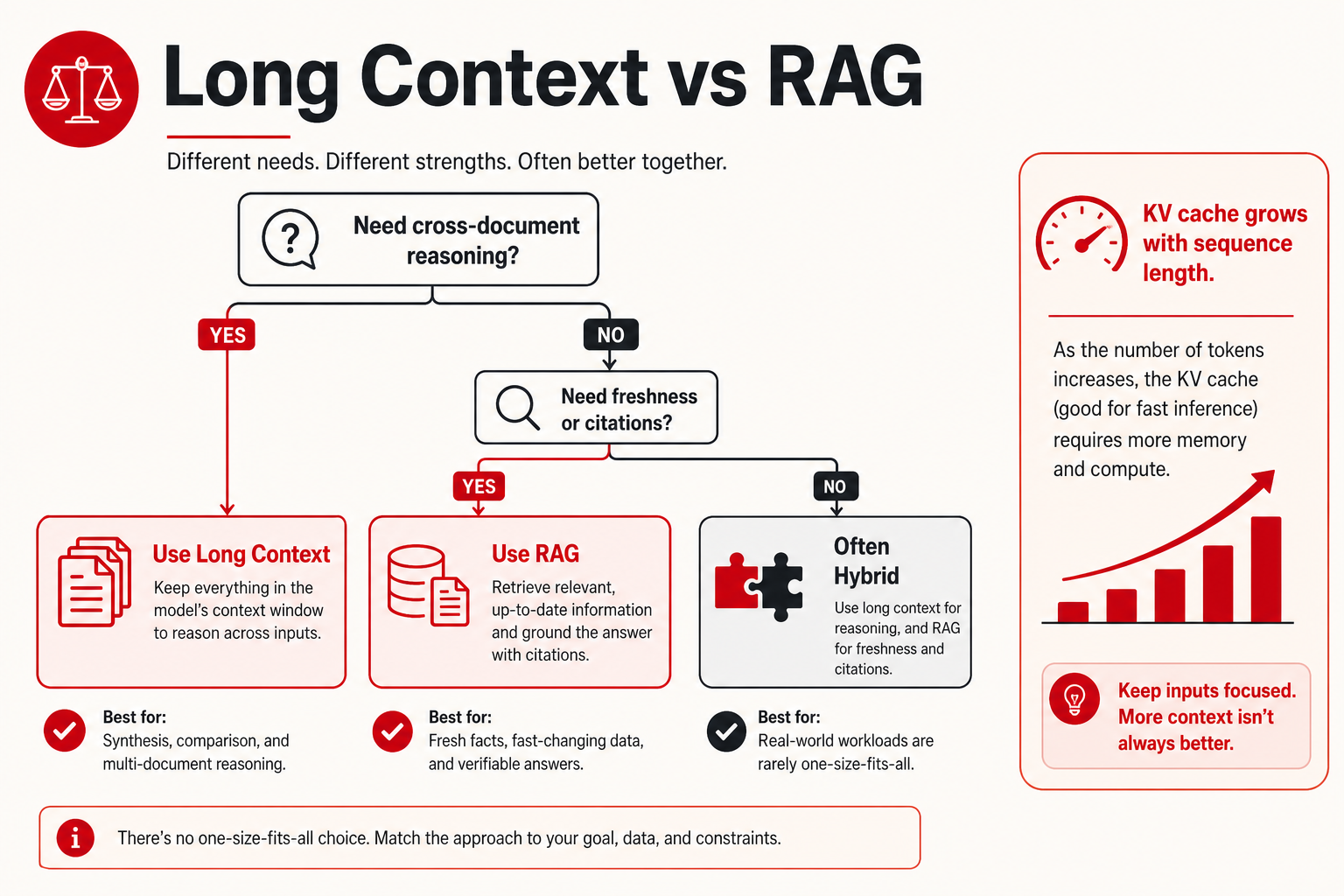
Long context—up to roughly one million tokens in marketing terms—is a capability some frontier models advertise for 2026, but usable long context in production is smaller: it is bounded by memory, latency, dollar cost, and retrieval quality degradation ("lost in the middle," attention dilution). Treat 1M as an upper bound to test, not a default prompt size. This how-to walks through when to fill the window vs when to chunk + RAG, how to estimate KV-cache pressure, how to verify with needle and task suites, and how to control spend on APIs and self-hosted open weights. Most teams should optimize structure before they maximize tokens.
Key takeaways
- Context window ≠ effective context—models may accept long inputs but answer poorly on middle sections without careful eval.
- KV-cache memory scales with sequence length; million-token prefills are batch and cost events, not free chat history.
- RAG + long context hybrid often beats either alone: retrieve narrow sets, use long window for cross-chunk reasoning.
- Agent memory needs policy, not infinite transcript paste (agent memory explainer).
- Access mode affects what's realistic—API pricing and self-host VRAM differ (open vs closed frontier).
Prerequisites
- A defined user journey (legal review, repo Q&A, support thread summarization, etc.) with sample documents at p95 size.
- Model endpoint that documents context limit and pricing for input tokens—note version ID.
- Token counter aligned with provider tokenizer or a consistent approximation for smoke tests.
- Baseline shorter-context or RAG pipeline for A/B—not greenfield hype.
- Read model stack 2026 for where context length is negotiated (pretrain/post-train) vs paid (inference).
Step 1: Decide if you need long context at all
Run this gate before engineering a million-token path:
| Question | If "yes" → consider long context | If "no" → prefer RAG/chunking |
|---|---|---|
| Must model reason across many distant sections in one pass? | Long context or hybrid | Chunk + retrieve |
| Is corpus static and repeated queries rare? | RAG index likely cheaper | Long paste each time wastes tokens |
| Are facts time-sensitive? | RAG with refresh | Long context embeds stale text |
| Is p95 doc size < 32K tokens? | Standard context may suffice | Skip 1M complexity |
| Will agents append tool outputs unbounded? | Memory policy required | Raw long context breaks spend |
The RAG pillar (RAG is not dead) remains relevant—long context did not retire retrieval for enterprise knowledge.
Step 2: Measure your token reality
Build a histogram of:
- User message + system prompt
- Retrieved chunks (if any)
- Tool returns in agent flows (chatbot to agent)
- Multimodal attachments—video and images inflate prefill (multimodal video explainer)
Use p95 and p99, not mean. A feature designed for "1M available" but operating at 8K p95 should not pay 1M infrastructure complexity.
Tokenizer discipline
Different models tokenize differently—legal PDF extraction can explode tokens with tables and headers. Normalize text (strip boilerplate, dedupe repeated headers) before counting. For open weights, Hugging Face tokenizers help; for APIs, use vendor counters when exposed.
Step 3: Understand memory and KV-cache (self-host and mental model for API)
During autoregressive decoding, transformers cache key/value tensors for prior tokens. Rough builder intuition:
- KV memory grows linearly with sequence length × hidden size × layers × batch.
- Long prefill is one expensive forward pass; subsequent output tokens add smaller incremental KV.
- Quantization (INT8/INT4 KV) helps but can harm quality—regression-test (quantization explainer).
Self-hosting million-token class models typically requires multi-GPU or aggressive quant—not laptop Ollama defaults. See run open-weight locally for honest sizing gates and inference economy for unit cost framing.
Step 4: Choose a pattern
Pattern A — Full-window paste
Send entire corpus in one prompt. Simplicity highest; cost and latency worst at scale. Use only when cross-document reasoning is essential and corpus size fits budget after normalization.
Pattern B — Hierarchical summarize
Map: chunk → partial summaries → reduce with long-context pass on summaries. Cheaper than raw 1M for corpora with redundant structure. Risk: summary loss—keep citations to source chunks.
Pattern C — RAG + long context buffer
Retrieve top-k chunks, plus reserve long window for user thread + tool trace + adjacent chunks for bridging. Often best enterprise default. Tune k and rerankers (RAG chunking and embeddings).
Pattern D — Structured memory for agents
Store facts in external memory; inject only relevant slices each turn. Prevents unbounded transcript growth (agent memory).
Step 5: Implement safely
- Pin model version and documented context maximum—marketing "1M" may be beta tier or require specific API flag.
- Enforce server-side caps below absolute max to protect spend; expose user-facing warnings at 80% budget.
- Strip secrets before logging contexts; long prompts amplify PII blast radius.
- Timeout and chunk fallback—if prefill exceeds SLO, degrade to Pattern B or C automatically.
- Cache static prefixes where vendor supports prompt caching—amortize repeated system + corpus headers.
Step 6: Verify quality (not just "it accepts input")
Needle-in-haystack (with caution)
Hide a unique fact at varied depths in synthetic haystacks. Useful sanity check; not sufficient alone—vendors optimize for this eval shape. Combine with real document tasks.
Task-specific suites
- Contract cross-reference: clause in appendix must affect answer in section 2.
- Codebase: symbol definition far from usage—pair with coding agent map (coding agents map).
- Support: resolution requires email #1 and #47 in thread.
Report accuracy vs depth position and vs context length tier (32K / 128K / 512K / max). Plot degradation curves, not single pass/fail.
Compare to RAG baseline
If long context does not beat a tuned RAG pipeline on p95 tasks, do not ship 1M for hero marketing—ship cheaper architecture.
Step 7: Control cost on APIs
Input tokens dominate long-context bills. Typical controls:
- Hard per-request input cap internal to product.
- Summarize history nightly for returning users.
- Diff documents—send only changed sections on re-run.
- Route "simple Q&A" to smaller context model (reasoning vs chat for when to escalate).
- Finance dashboard: cost per successful task, not cost per request average.
Compare API long-context SKUs vs self-host with self-host vs API TCO when p95 inputs exceed six figures tokens regularly.
Step 8: Self-host long context (when open weights fit)
Open models advertising 128K–1M class windows need serving stacks that support extended RoPE or yarn-style scaling—verify in model card and runtime release notes. vLLM / SGLang / TensorRT-LLM paths differ (vLLM in production).
Checklist:
- Confirm instruct checkpoint quality at long lengths—not base model.
- Load test prefill at p99 token count; watch OOM and p95 latency.
- Quantize KV only after structured-output regression passes.
- Document max concurrent long requests—one 500K job can evict cluster.
Failure modes table
| Failure | Symptom | Mitigation |
|---|---|---|
| Lost in the middle | Misses facts placed mid-document | Re-order important text; RAG pointer; multi-pass |
| Attention dilution | Vague answers on huge paste | Hierarchical summarize; tighter retrieve |
| Cost blowout | Margin collapse on agent loops | Memory policy; caps; model routing |
| Latency timeout | Prefill > gateway limit | Async jobs; chunk fallback |
| False confidence | Fluent wrong citations | Require quotes; faithfulness eval (retrieval eval) |
| Stale corpus | Old policy quoted as current | RAG refresh; version dates in prompt |
| OOM on self-host | Serving crash under load | Queue; shorter max; multi-GPU; KV quant |
Worked example: contract review without fake precision
Imagine a p95 180-page agreement (~220K tokens after boilerplate stripping). Three architecture options:
- Full paste into a 512K+ window: one call, highest prefill bill, test middle-clause recall explicitly.
- RAG + 32K buffer: retrieve clauses by section embedding; model sees top 40 chunks + user question; cheaper, may miss cross-reference unless graph links exist (GraphRAG).
- Hierarchical: summarize each article into structured JSON (obligations, dates, parties), merge summaries (~15K tokens), final reasoning pass—adds pipeline ops, often best cost/recall tradeoff.
None is universally correct. Legal desks should grade outputs with attorney review on a frozen corpus before choosing hero marketing ("whole deal room in one prompt").
Vertical notes: legal, finance, and code
Legal and compliance
Long context tempts teams to skip citation discipline. Require quoted spans with page/line pointers; run faithfulness checks against source text (retrieval faithfulness eval). Vertical RAG guides add domain retention rules (vertical RAG).
Finance and research
Earnings transcripts, 10-K bundles, and analyst models span years—freshness matters more than raw span. Long context holds historical narrative; RAG indexes latest filings. Hybrid with explicit as-of dates in prompts reduces silent staleness.
Code repositories
"Whole repo in context" rarely beats indexer + selective file pull for IDE agents at scale. Long context helps when the model must relate distant modules in one reasoning pass—validate against your monorepo's p99 file count and tokenized size. Coding agent comparisons (coding agent tools compared) show toolchain effects beyond window size.
Production monitoring for long-context features
Dashboards should segment long requests from normal chat:
- Prefill duration vs decode duration—regressions often hit prefill first.
- Truncation events—silent server-side trims destroy trust.
- Fallback path rate—how often chunk/RAG backup triggers.
- Cost per successful task—include human edit time in internal quality metrics.
- Position-stratified error rate—if middle quartile fails 2× top/bottom, window marketing oversells.
Alert when p95 input tokens cross internal tier boundaries—you may need routing policy updates before finance notices.
Needle tests: how to run them without fooling yourself
Public "needle" evals insert a random fact in a long haystack. Useful rules:
- Vary **depth** at 10%, 50%, 90% of token length.
- Use **domain-shaped haystacks** (fake contracts, code files)—random lorem ipsum overstates quality.
- Run **multiple needles**—models that find one may miss two interacting facts.
- Compare **same task with RAG**—if RAG wins, long context is a cost choice, not quality mandate.
- Re-run after **every quant or kernel upgrade** on self-host paths.
Report results internally; avoid publishing vendor-style single-number "100% needle" claims without harness disclosure.
API flags, tiers, and "available vs enabled"
Vendors often ship long context as beta tiers, allowlisted accounts, or separate SKUs. Builders should document:
- Whether 1M is **marketing maximum** or **default enabled** for your key.
- If **reasoning modes** consume hidden tokens that count toward the same window.
- Whether **batch API** supports longer effective runs with different timeouts.
- Regional differences—EU vs US endpoints sometimes diverge on limits.
Test with the same API key production uses; staging keys may sit on more permissive tiers that mislead load tests.
Context budgeting worksheet (team exercise)
Run this workshop once per major feature:
- List top five user journeys with example payloads (files, threads, tool logs).
- Tokenize p50/p95/p99; mark which segments are static vs dynamic.
- Assign **budget caps** per segment (system 2K, RAG 8K, user thread 4K, reserve 4K).
- Identify what must be **summarized or dropped** when over budget—never silent truncate.
- Re-evaluate after adding agents or multimodal attachments (multimodal video).
Output lives in the repo beside feature flags so PM and infra share one source of truth.
When labs advertise 1M: desk questions to ask
Release posts for extended context should trigger internal questions aligned with lab watch:
- Is extension **pretrain-native** or **RoPE scaling / yarn** on existing weights?
- Did evals report **position-stratified** accuracy or single needle demos?
- What **price multiplier** applies to input tokens above prior tier?
- Does open-weight release match API context claims same week?
Answers determine whether you re-run hybrid RAG architecture or simply raise an internal cap.
Scaling-law perspective
Longer context is not free capability—training and inference costs rise with sequence length extensions. Diminishing returns apply: past your task's needed span, extra tokens hurt more than help (scaling laws). Read vendor claims through inference economics, not bragging rights (leaderboard literacy).
Agent loops and context growth
Agents accumulate tool outputs, stderr logs, and retrieved pages each step (chatbot to agent). Long context marketing encourages "just paste the trace"—that path destroys margin. Patterns that work:
- Compaction summaries after N tool steps with structured fields (goal, state, open questions).
- External memory tables keyed by entity ID (agent memory).
- Hard step caps with user confirmation before continuing expensive chains.
- Router to smaller context models for tool selection; escalate to long-window only for synthesis.
Measure agent trajectories in tokens per successful outcome, not per request.
Self-host vs API at million-token scale
At extreme input lengths, API list prices can exceed amortized GPU hours—or the reverse if utilization is low. Walk through self-host vs API TCO with **your** p99 token histogram, including failed requests that still billed prefill. Open-weight long-context often needs multi-GPU configs documented in model cards; closed APIs may offer dedicated capacity tiers with opaque discounts—finance needs both scenarios modeled.
Chunking parameters that interact with long context
Even with a large window, chunk size in RAG affects quality. Oversized chunks waste tokens; undersized chunks lose relational context. Tune:
- Chunk overlap—typically 10–20% for prose; lower for structured logs.
- Metadata headers prepended to each chunk (title, section, date).
- Reranker budget—retrieve 50, rerank to 8, inject 8 into long buffer for synthesis.
- Graph edges for cross-references in contracts and code (GraphRAG).
Revisit chunking when you raise context caps—what failed from retrieval may now succeed with hybrid, but cost rises either way (RAG chunking guide).
Disaster recovery: when long requests fail
Long prefills fail more visibly than chat turns. Runbooks should include:
- Automatic retry with **half context** (summarized haystack).
- User-visible message explaining degradation path—not opaque 500 errors.
- Queue placement for async long jobs vs synchronous chat pool isolation.
- Incident tag
long_context_prefillfor postmortems.
Pair with inference ops guides (vLLM in production) when self-hosting.
Checklist summary (printable)
- Gate: do you need long context vs RAG?
- Measure p95/p99 tokens per journey.
- Pick pattern: full window, hierarchical, RAG hybrid, or agent memory.
- Implement caps, fallbacks, and logging.
- Run depth-stratified eval + RAG baseline.
- Model API/self-host cost at p99.
- Document in registry; set quarterly review.
This sequence keeps million-token features from becoming million-dollar surprises—especially when paired with inference economy reviews.
For teams still standardizing on sub-128K windows, treat this how-to as forward-looking architecture—most steps (measure, gate, hybridize, eval) apply before you ever enable a maximum-context SKU.
Related pillars you will link in production docs
Long-context features rarely stand alone. Most production write-ups also link:
- RAG is not dead — when retrieval remains primary.
- Open vs closed — who bills the prefill.
- Leaderboards — decoding context claims in launch posts.
- Knowledge worker stack — UX for large document workflows.
- Scaling laws — why longer windows have diminishing returns.
- Run open-weight locally — self-host sizing for long prefills.
Document which links apply to your feature in the PRD so support and infra do not discover RAG-vs-long-context debates at launch week. Revisit the checklist after any agent or multimodal attachment changes token mix materially.
Who this is for
- Platform engineers implementing context limits and fallbacks.
- PMs writing PRDs for "whole repo" or "whole deal room" features.
- Legal / finance / research desks evaluating vendor long-context SKUs.
- Agent builders preventing runaway transcripts.
Who should skip
- Teams with p95 inputs under standard 32K–128K windows and working RAG—optimize retrieval first.
- Readers seeking a single "enable 1M flag" tutorial without eval and cost gates.
- Anyone expecting laptop-local million-token models for daily use without datacenter hardware.
Common mistakes
| Mistake | Why it fails | Better move |
|---|---|---|
| Pasting entire wiki because window allows it | Noise + cost | Retrieve + long buffer hybrid |
| No position-aware eval | Hidden middle failures | Depth-stratified test set |
| Using marketing max as default | Latency and bill shocks | p95-sized default cap |
| Agents without memory compaction | Exponential token growth | Structured memory |
| Skipping RAG baseline comparison | Over-engineering | A/B on real tasks |
FAQ
Does 1M context replace RAG?
Rarely for enterprise knowledge. Long context helps cross-chunk reasoning within a session; RAG helps freshness, scale, and cost at corpus level. Hybrid is common.
How do I estimate API cost for long inputs?
Multiply p95 input tokens by input price per million (verify vendor table date). Add output tokens and agent loop multiplier—do not extrapolate from one demo prompt.
Why does the model "accept" 400K tokens but fail my task?
Window size is not uniform quality across positions. Run depth-stratified evals and compare shorter retrieves.
Are reasoning models better at long context?
Reasoning modes may help complex multi-hop tasks but can add hidden reasoning tokens and latency (reasoning vs chat). Test total cost, not only accuracy.
What should we log in production?
Input/output token counts, model version, retrieve hit rate, latency phases (prefill vs decode), fallback path taken, and human correction rate.
Can prompt caching replace RAG?
Caching helps repeated static prefixes (system prompts, standard corpora headers); it does not refresh facts or shrink haystack noise. Use cache for cost on stable prefixes, RAG for dynamic knowledge, long buffer for cross-chunk reasoning in one session.
How do we talk to leadership about 1M marketing?
Translate to p95 token use, cost per successful task, and depth-stratified eval—not maximum window size. Leadership cares about margin and reliability; engineers should lead with measured tradeoffs, not technical ceiling bragging.
Does fine-tuning fix long-context retrieval failures?
Sometimes for format and domain tone, rarely for fundamental position bias or missing cross-document reasoning. Prefer retrieval architecture and eval before a fine-tune project justified only by long-paste marketing hype. If fine-tune wins, log which context lengths improved—not just aggregate accuracy.
Sources
- "Lost in the Middle: How Language Models Use Long Contexts" (Liu et al.) — positional degradation research.
- Hugging Face Documentation — tokenizers and long-context model cards.
- vLLM Documentation — serving and memory concepts for self-hosters.
What we did not test: We did not run a proprietary million-token needle benchmark across all frontier models for this article. Memory and cost guidance is methodological desk synthesis—not EIA-published latency or accuracy tables.
Corrections: Update context maximums, pricing examples, and API flag names when vendors change SKUs—refresh as-of date at top.
Next step
If long context wins your eval, align access and serving in open vs closed frontier. If RAG wins, implement chunking in RAG chunking guide. Agent products should read agent memory before raising context caps again.