
Evidence note: Models Desk synthesis from public model cards, official lab documentation, license notes, and deployment patterns as of 2026-08-17; no universal model ranking is implied.
Quick answer
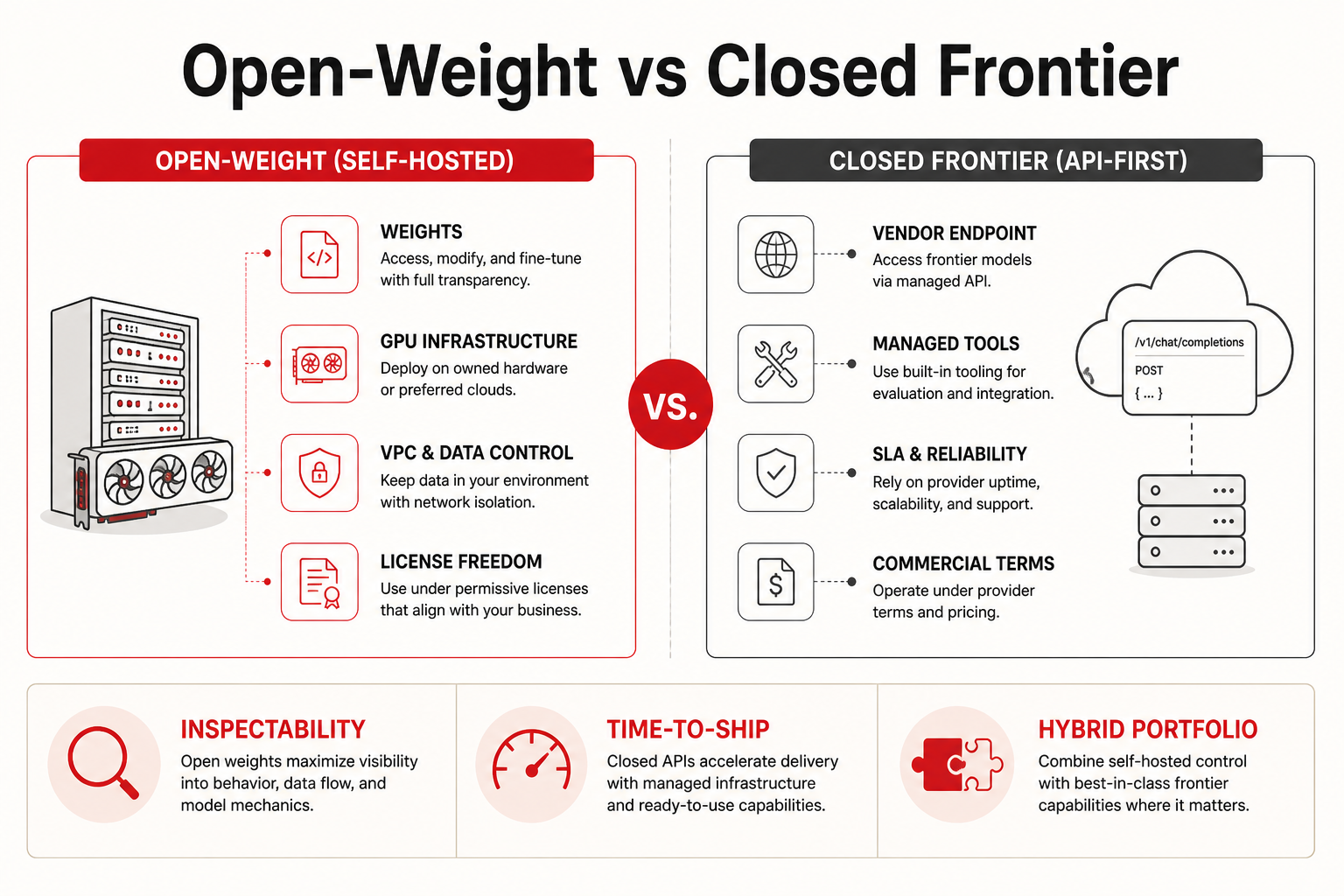
The open-weight vs closed frontier choice is not a morality play or a single leaderboard row—it is a product and operations decision. Closed frontier APIs bundle the latest post-trained behavior, managed inference, and vendor safety layers; you optimize prompts, RAG, and routing while accepting opacity, rate limits, and data-handling terms. Open-weight releases give you checkpoints, licenses, and the option to self-host or fine-tune; you own inference economics, compliance evidence, and upgrade cadence. In 2026, most production teams run hybrid stacks: closed models for hard reasoning or multimodal steps, open models for extraction, embeddings, air-gapped workloads, and cost-controlled volume. Pick based on access mode, unit economics at your context lengths, and legal constraints—not on arena hype alone.
Key takeaways
- Capability gap between top closed APIs and best open weights narrows on many tasks but is not uniform—reasoning, long context, and frontier multimodal still diverge by release week.
- Open-weight wins on inspectability, customization, data residency, and predictable marginal cost at scale—when you can operate serving.
- Closed frontier wins on time-to-ship, managed safety, and access to unreleased training recipes—when ops headcount is thin.
- License terms (commercial use, attribution, export) matter as much as benchmark scores—see M6/M8 clusters in our stack map (model stack 2026).
- Read public scores with layer context (how to read AI leaderboards); run private smoke before switching production traffic.
Who should read this debate
This compare is for engineering leads, ML platform owners, and procurement teams choosing a default model strategy for 2026—not for readers hunting a permanent "#1 model" label. If you need step-by-step local serving, start with run open-weight LLM locally. If you are sizing whether bigger models are worth it, pair this with scaling laws: where returns diminish. If your workload is agent-heavy, add chatbot to agent map because access mode changes token volume and failure blast radius.
Definitions: what "open-weight" and "closed frontier" mean here
Open-weight (and open-ish)
Open-weight means downloadable parameters published under a stated license—often via Hugging Face, vendor GitHub, or a gated research form. Variants include:
- Truly open licenses (e.g., permissive or community licenses with commercial terms spelled out)—Meta Llama family, many Mistral and Qwen releases, DeepSeek checkpoints where license allows your use case.
- Research / non-commercial weights—useful for eval, risky for product without legal review.
- Open weights + closed data/recipe—you get checkpoints but not full pretrain/post-train reproducibility.
Open-weight is not synonymous with "free inference." You still pay in GPU time, engineer hours, and eval debt. The 2026 model stack separates base vs instruct checkpoints: a raw base model is not a product-ready assistant without post-training you own or community instruct variants.
Closed frontier
Closed frontier means state-of-the-art or near-frontier models available only through vendor APIs, enterprise contracts, or hosted chat products—weights not published for download. Training details are partial; behavior changes ship as version bumps. Examples in public discourse include flagship chat/reasoning endpoints from OpenAI, Anthropic, Google DeepMind/Gemini, and similar labs—verify current product names on official sites when purchasing.
Closed does not mean "no customization." Fine-tuning APIs, distillation programs, and VPC deployments exist for some vendors—but you still do not inspect full weights or run arbitrary post-train without vendor tooling.
Comparison table: open-weight vs closed frontier
| Facet | Open-weight | Closed frontier |
|---|---|---|
| Weight access | Download checkpoints; pin revisions | API-only; vendor controls versions |
| Transparency | Architecture + weights inspectable; training data often vague | Model cards partial; behavior observable via API |
| Time to first prototype | Slower if self-hosting; fast with Ollama-style runtimes for mid-size models | Fastest with API key and SDK |
| Marginal cost at scale | Can improve with utilization, quantization, owned hardware | Per-token pricing; enterprise discounts opaque |
| Customization | Full fine-tune, LoRA, merge, distillation on your data | Vendor fine-tune / prompt / RAG; limited depth |
| Data residency / air-gap | Strong when self-hosted in your VPC | Depends on vendor region, ZDR, enterprise terms |
| Safety & refusals | You inherit base + community instruct; red-team is your job | Vendor post-train + policy layers; changes without notice |
| Capability freshness | Trailing frontier by weeks–months unless you are the lab | Often first access to new reasoning / multimodal features |
| Compliance narrative | License + your ops evidence | Vendor attestations, DPAs, audit letters |
Where open-weight wins (and when it does not)
Cost and inference control
When traffic is high and contexts are long, self-hosted open weights can beat API unit economics—if utilization is healthy. The mistake is spreadsheet TCO that ignores engineer time, on-call, and eval regressions after every quant experiment. Our inference pillar (inference economy) and compare (self-host vs API TCO) stress token budgets and p95 context, not demo prompts.
Open models also enable routing tiers: a 7B–14B instruct model for classification and extraction, a larger open model for batch jobs, closed API for verification steps. That pattern shows up in knowledge-worker stacks (AI app stack for knowledge workers).
Customization and lineage
Teams with proprietary terminology, structured output schemas, or domain adapters often need LoRA/SFT on open checkpoints. Closed APIs improve with prompt engineering and RAG, but you cannot merge adapters or ship a frozen checkpoint to a regulator. Lineage discipline—base vs instruct vs your fine-tune—is covered in the model stack explainer.
Sovereignty and geopolitics
Public-sector, defense-adjacent, and regulated industries sometimes must run weights on owned hardware. Open-weight is not automatically compliant—license export clauses and training-data disputes still apply (open source geopolitics in AI, sovereign AI and export controls). Closed vendors offer regional endpoints and enterprise controls; open weights offer air-gap if you can operate them.
When open-weight loses
- You need frontier reasoning or multimodal video quality today with minimal ops—closed APIs often lead until open catches up (reasoning vs chat models, multimodal video explainer).
- Your team has no serving expertise and low traffic—API simplicity dominates.
- You require vendor indemnity / enterprise SLAs you cannot replicate internally.
Where closed frontier wins (and when it does not)
Time-to-ship and managed safety
Startups and feature teams frequently ship on closed APIs because post-training and safety tuning are bundled. Refusals, formatting, and tool-call behavior improve on vendor cadence—you re-test on version bumps, not rebuild training pipelines. For agents with tool use, managed endpoints reduce the gap between demo and production (chatbot to agent).
Frontier capabilities
Closed labs still drive many first releases of long-context products, reasoning modes, and native multimodal features documented in public posts. Open ecosystems close the gap quickly on popular architectures—but "same benchmark score" does not mean same latency or tool reliability at your scale. Track labs without treating marketing as proof (lab watch: frontier labs 2026).
When closed frontier loses
- Runaway token bills on agent loops or million-token contexts—see long context in practice.
- Hard data residency where vendor regions or logging cannot be negotiated.
- Need for reproducible checkpoints in audit trails (finance, legal tech).
- Vendor lock-in fear when a single model ID is your entire product brain—mitigate with abstraction and hybrid routing.
Capability: how to compare without fake rankings
We do not publish a "#1 open" or "#1 closed" table—scores rot weekly and benchmarks mix layers. Use this desk method instead:
- Freeze a task suite tied to revenue (support deflection, code review, doc Q&A)—not generic MMLU.
- Match access mode: compare instruct open checkpoint vs vendor chat/reasoning endpoint with documented version IDs.
- Log tokens and latency at p95 context—leaderboard rows rarely include your RAG payload (leaderboard guide).
- Separate reasoning from chat—extended thinking modes behave differently (reasoning vs chat).
- Re-run after quant or routing changes—open-weight gains are often serving-side.
Public sources for capability context (not endorsements): Hugging Face documentation, vendor research hubs such as OpenAI Research and Meta AI Blog, and task-specific leaderboards named in release posts—always note checkpoint date.
Cost and serving: the hidden debate
Sticker price comparisons mislead. Closed APIs charge per million tokens with list prices that change; open self-hosting amortizes GPUs and burns engineer time. Typical patterns:
- Burst / prototype traffic: API often cheaper all-in.
- Steady high QPS with batchable workloads: open serving can win above a utilization threshold.
- Long-context workloads: KV-cache memory dominates; open weights let you tune quant and batching—closed products may price context as premium SKUs.
- Agent products: multiply calls per user action; hybrid routing is common.
Quantization and speculative decoding change open-weight economics (quantization and speculative decoding). Closed vendors hide those knobs behind product tiers.
Security, license, and misuse
Open-weight releases shift misuse risk toward deployers: jailbreaks, uncensored fine-tunes, and unfiltered endpoints are community-visible problems. Closed vendors implement centralized policy—but prompt injection and agent risks remain (jailbreak and agent risks, practical AI safety for builders).
License review checklist (legal counsel required—we are not lawyers):
- Commercial use allowed for your SKU?
- Attribution and acceptable use policy?
- Export / sanctioned-region restrictions?
- Derivative works and fine-tune redistribution?
- Training-data litigation exposure your org accepts?
Hybrid architectures that actually ship
Pure "all open" or "all closed" strategies are rarer in production than conference talks suggest. Common hybrid patterns:
| Pattern | Open-weight role | Closed frontier role |
|---|---|---|
| RAG copilot | Embeddings + reranker + small instruct for cite formatting | Hard reasoning on escalations |
| Coding agent | Local fast autocomplete model | Cloud model for multi-file refactors |
| Regulated doc review | Air-gapped mid-size instruct | None—or VPC enterprise only |
| Consumer app | None initially | Default API until unit economics force optimize |
| Multimodal pipeline | Self-hosted vision encoder where license allows | Video understanding API where open lagging |
Agent orchestration amplifies hybrid value (multi-agent orchestration)—different steps tolerate different cost and opacity.
The scaling-law backdrop
Both open and closed frontier models ride the same rough scaling curves—more compute and data tend to lift capability until diminishing returns (scaling laws). Closed labs spend capex on pretrain; open releases often trail by a release cycle but compress price-performance for builders. Your decision is not "which scales better" but which access mode fits your layer: pretrain (buy vendor), post-train (own or vendor), inference (self or API).
Enterprise procurement: questions for vendors and open releases
Procurement teams often receive a binary slide: "open is free, closed is safe." Reality is a questionnaire. Use these prompts in RFPs and internal gate reviews—answers belong in your model registry, not in a Slack thread.
| Topic | Closed API ask | Open-weight ask |
|---|---|---|
| Data retention | Zero-retention tier? Logging scope? Subprocessors? | N/A for self-host; cloud deploy still needs logging policy |
| Training on customer data | Opt-out/default? Contract clause cite? | Weights local; verify telemetry in runtime |
| Model version pinning | Deprecated ID timeline? Migration support? | HF revision hash pinned? Who updates quant builds? |
| Region / residency | Available regions and failover | Hardware location you control |
| Indemnity / liability | Enterprise package terms | License disclaimer; your misuse policy |
| Audit artifacts | SOC2, ISO, model card links | License text, SBOM for serving stack |
Pair vendor answers with practical AI safety for builders and agent risk notes if tools touch customer systems.
Fine-tuning, distillation, and where each access mode wins
Full fine-tuning on proprietary workflows—support macros, internal APIs, clinical note formats—remains easier to operationalize on open instruct checkpoints where you control data flow and export merged adapters. Closed fine-tune programs exist but constrain export and inspection; acceptable when the vendor hosts the only copy you need.
Distillation—using a large teacher (often closed API) to label data for a smaller student (often open-weight)—is widespread but ToS-sensitive. Document teacher version, label date, and student eval before shipping. Distillation does not transfer license rights; it compresses behavior you measured at a point in time.
LoRA libraries accumulate in open ecosystems; closed APIs rarely expose adapter marketplaces you can merge. If your moat is domain adapters, bias open unless enterprise fine-tune contracts meet export needs.
Observability: pinning versions across open and closed
Production incidents often trace to silent version drift. Closed APIs change default routing; open deployments pull "latest" tags. Minimum observability fields:
- model_id string exactly as billed (API) or checkpoint hash (open).
- quantization profile for self-hosted paths.
- prompt template version separate from weight version.
- retrieval index version when RAG hybridizes either access mode.
Agent loops amplify drift cost—log per-step model ID (agent observability). When a lab post announces "same model name, improved reasoning," your registry should treat it as a candidate release, not a no-op.
Industry-shaped patterns (illustrative, not prescriptions)
Fintech and health often start closed for speed, then introduce open tiers for PII-heavy batch extraction in VPC. Regulatory questions focus on logging and BAA/DPA analogs—not on benchmark scores.
Developer tools frequently hybrid: local open autocomplete, cloud frontier for multi-file refactors (coding agents map). Latency sensitivity pushes open small models to the edge.
Media and moderation may require open vision-language models on-prem for unreleased footage, with closed APIs for generative assist where license allows (multimodal video).
Government and defense-adjacent workloads skew open self-host with air-gap, subject to export controls on weight origin (sovereign AI). Closed vendor VPC offerings compete when accreditation paths exist.
Decision tree: pick a default for the next quarter
- Hard gate: Must weights stay in your VPC / offline? → Open or vendor VPC; if offline-only → open self-host.
- Team: No ML ops? → Closed API until pain threshold.
- Task: Needs frontier reasoning/multimodal today? → Closed or largest open instruct; validate with smoke.
- Volume: Token forecast high? → Model TCO (self-host vs API).
- Customization: Needs proprietary fine-tune evidence? → Open-weight instruct base.
- Default: If none force a side, start closed for speed; instrument cost; introduce open tiers when metrics justify ops.
Migration playbook: switching access modes without downtime drama
Teams switch open → closed, closed → open, or vendor A → vendor B under pressure from cost, policy, or deprecations. A sober playbook:
- Freeze prompts and eval sets before touching weights or API IDs.
- Shadow traffic at 5–10% with compare logging (latency, tokens, structured-output validity).
- Define rollback triggers—e.g., >2 pt drop on critical task or p95 latency regression >30%.
- Update runbooks for secrets, rate limits, and regional endpoints separately from app code.
- Communicate license changes to legal if open weights enter or leave the path.
Hybrid stacks migrate one tier at a time (embeddings first, then router, then frontier)—not all models on launch day. Pair with buy vs build decision tree when migration becomes a product rewrite.
Who this is for
- Platform leads drafting a model routing policy for 2026.
- Founders choosing MVP stack without over-building infra.
- Compliance / security partners who need plain-language access tradeoffs.
- Researchers comparing reproducible open checkpoints to opaque API versions.
Who should skip
- Readers wanting a single ranked list of "best models"—use task guides and private evals.
- Teams already standardized on one vendor with no pain—optimization can wait.
- Anyone seeking legal advice on licenses—we flag issues; counsel decides.
Common mistakes
| Mistake | Why it fails | Better move |
|---|---|---|
| Choosing open weights to avoid API cost without utilization plan | Idle GPUs + on-call exceed token bills | Start API; migrate with TCO model |
| Assuming open = no vendor lock-in | Framework, eval, and prompt investment still sticky | Abstract model provider; hybrid smoke tests |
| Shipping base checkpoint without instruct tuning | Poor format and safety | Use instruct variant or SFT |
| Trusting arena Elo for enterprise JSON workflows | Preference ≠ schema reliability | Private structured-output suite |
| Ignoring license on commercial launch | Product risk | Legal review before fine-tune ship |
| Single closed model for all agent steps | Cost explosion | Tiered open/closed routing |
FAQ
Are open-weight models always behind closed frontier?
Not on every task or week. Open releases often match or beat closed models on specific benchmarks shortly after a major open drop—but frontier multimodal, reasoning modes, and product integration still often lead on closed APIs first. Evaluate on your suite, not headline gaps.
Is open-weight the same as open source?
No. Weights may be downloadable while training code, data, and some licenses remain restricted. Read the license and model card; "open-weight" is the accurate builder term when code is not fully open.
Can we fine-tune a closed API model?
Some vendors offer fine-tuning or distillation programs on their platforms—you do not get arbitrary weight surgery offline. For full checkpoint control, use open instruct models.
What about distillation from closed to open?
Common pattern when terms allow: teacher on API, student open-weight for cheap inference. Verify vendor ToS and log regression on edge cases; distillation is post-training, not a license workaround.
How often should we revisit open vs closed?
Typical product teams review quarterly at scale, or immediately after major open releases (lab watch) and when token spend crosses internal thresholds.
What documentation should we keep for auditors?
Maintain a model registry with version IDs, license URLs, data-flow diagrams, and eval summaries. Open-weight paths need checkpoint hashes and serving configs; closed paths need contract exhibits and zero-retention confirmations. Update the registry on every allowlist change—not only on major launches.
Sources
- Hugging Face Documentation — open-weight hosting, licenses, and inference guides.
- OpenAI Research — closed-model research and release notes (verify specific product pages).
- Meta AI Blog — Llama-family open-weight announcements and license context.
What we did not test: We did not run a head-to-head private benchmark across all open and closed frontier models for this article. Comparisons are framework-level desk synthesis from public documentation and typical deployment patterns—not EIA-measured rankings.
Corrections: When major labs change default licenses, API terms, or open-weight release cadence, update the comparison table and as-of date— not isolated superlatives in the SEO title.
Next step
If open-weight is viable for you, run run open-weight LLM locally on a pinned instruct model and smoke-test against your current API. If you stay closed, read long context in practice to avoid surprise token bills—and lab watch to track releases without hype.