
Important disclaimer: This article describes engineering and governance patterns for research-assistance systems. It is not legal advice, medical advice, financial advice, investment advice, or a compliance determination. Licensed attorneys, clinicians, financial professionals, compliance officers, and other qualified reviewers remain accountable for decisions. Always consult qualified professionals for your jurisdiction, patient or client population, product claims, and intended use before deploying vertical RAG in production.
Quick answer
Vertical RAG for legal, medical, and finance must combine jurisdiction-aware corpora, mandatory citations with version dates, access-controlled retrieval, audit trails, and explicit not advice disclaimers in product UX. AI can accelerate search, drafting, and summarization over approved sources; it must not autonomously diagnose patients, render legal conclusions, personalize investment recommendations, or execute trades from retrieved snippets without human professional review and firm policy gates. Evaluate retrieval recall and answer faithfulness separately (RAG eval guide), and treat safety and injection risks as first-class (practical AI safety for builders).
Key takeaways
- Research assistance only—not a substitute for licensed professional judgment.
- Cite primary sources with effective dates; stale indexes create liability exposure.
- ACLs, logging, and retention policies are non-optional in regulated workflows.
- Numeric and clause-level hallucinations are high-impact; prioritize faithfulness metrics.
- Regional rules differ; EU AI Act high-risk categories may apply to some medical or HR-adjacent systems—verify with counsel.
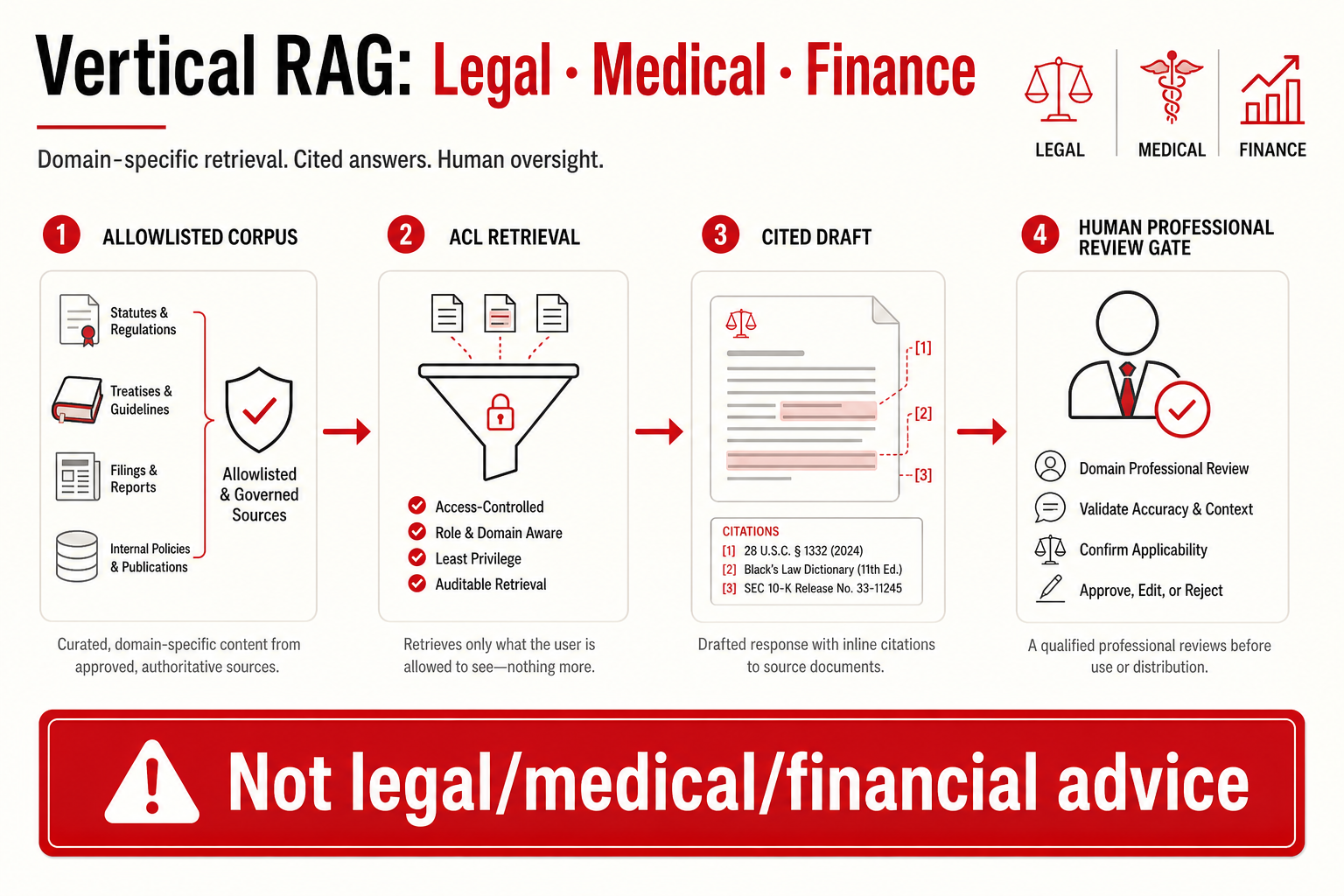
Why vertical RAG is not “generic RAG with a logo”
Generic enterprise RAG optimizes findability and helpful summaries. Regulated verticals optimize defensibility: who saw which source, whether the answer exceeded retrieved evidence, whether the user was warned about limitations, and whether the corpus was licensed for machine-assisted use. A retrieval miss in a marketing FAQ is annoying; a retrieval miss on contraindications, margin requirements, or contract termination clauses can harm people or firms.
The technical stack—chunking, embeddings, hybrid search, optional GraphRAG—matches general patterns (chunking guide, GraphRAG). The difference is governance layer thickness, eval rigor, and human-in-the-loop placement (RAG pillar).
Cross-vertical requirements
| Control | Purpose | Typical implementation |
|---|---|---|
| Source allowlisting | Prevent unvetted web retrieval | Index only approved libraries |
| Version/effective dating | Avoid stale policy/law | Metadata filters at query time |
| Mandatory citations | Audit and verification | Chunk IDs + page/section anchors |
| Human review gates | Professional accountability | Draft → reviewer → release |
| Disclaimers in UX | Set user expectations | Persistent banner + per-answer footer |
| Access control | Tenant and role isolation | Pre-retrieval filters on index |
| Audit logs | Regulatory inquiry response | Query, chunks, model version, user |
| Eval harness | Prevent silent regressions | Recall + faithfulness holdouts |
Legal desk patterns
High-value, lower-risk starts
- Clause and precedent search across firm-approved repositories with citation-first UX.
- Contract comparison highlighting diffs between template versions—human attorney interprets impact.
- Redline suggestions presented as drafts requiring explicit acceptance.
- Matter-aware Q&A scoped to client documents with conflict checks enforced outside the LLM.
What not to automate
- Final legal conclusions on jurisdiction-specific obligations without attorney sign-off.
- Privilege-sensitive routing decisions inferred solely from model outputs.
- Filings or external communications sent without human approval.
Corpus and licensing
Legal databases often restrict automated indexing or derivative use. Verify license terms before ingesting Westlaw-class, Lexis-class, or publisher PDFs—desk synthesis cannot substitute for contract review. Track provenance for training-vs-inference boundaries separately from RAG index rights.
GraphRAG in legal
Clause cross-reference graphs and party–obligation networks help multi-hop questions (“which exhibits reference indemnity cap in MSA v4?”). Extracted graphs require validation; operational matter metadata should come from DMS systems of record (GraphRAG enterprises).
Medical and clinical patterns
Clinical decision support vs general chat
Many markets regulate software intended to diagnose, treat, or drive clinical decisions. A “helpful medical chatbot” retrieval stack may still be a regulated medical device depending on intended use, claims, and jurisdiction. Product, regulatory, and clinical leaders must classify the product—not engineering alone.
Lower-risk research assistance patterns
- Literature search over licensed journal corpora with citations—physician interprets applicability.
- Hospital policy lookup for staff workflows with version dates.
- Documentation drafting aids where clinicians edit every line.
High-risk patterns requiring extreme caution
- Patient-facing triage or symptom checkers without clinical validation programs.
- Dose or interaction answers without verified structured drug databases and guardrails.
- Autonomous updates to electronic health records from retrieved text.
Numeric and table fidelity
Clinical content is table-heavy. Structure-aware chunking and faithfulness eval are mandatory (eval guide). A hallucinated decimal in dosing context is categorically worse than a vague prose summary.
Finance desk patterns
Research and compliance assistance
- Policy and procedure lookup for analysts and operations with audit logs.
- Research memo drafts citing 10-K chunks and internal models—human analyst validates.
- Client communication drafts with compliance pre-approved language libraries retrieved, not invented.
Model risk management (MRM)
Banks and asset managers often subject models to inventory, validation, and monitoring under internal MRM policies. RAG stacks count when outputs influence decisions or client-facing materials. Document data lineage, eval methodology, and change management when embedders or generators upgrade (model stack).
MNPI and market abuse walls
Retrieval indexes must respect material nonpublic information walls and role boundaries. Cross-division leakage via shared vector indexes is a compliance failure mode, not a model quality issue. Segment indexes per desk; enforce ACLs pre-retrieval.
What not to automate
- Autonomous trade execution based on retrieved news snippets.
- Personalized investment recommendations without suitability review and disclosures.
- Regulatory filings generated without human certification.
Disclaimers and UX copy (templates, not legal text)
Work with counsel to localize; engineering should reserve UI surfaces early:
- Persistent banner: “AI-assisted research; not professional advice.”
- Per-response footer: “Verify citations before relying; model may omit context.”
- Unanswerable states: Explicit abstention when retrieval confidence low—better than guessing.
- Effective date display: Show document version next to each citation.
Disclaimers do not eliminate regulatory obligations but reduce user harm and support informed use.
Safety, injection, and agent risks
Vertical corpora may contain adversarial text (malicious PDFs, poisoned tickets). Retrieved injection can steer answers or exfiltrate instructions. Mitigations include source allowlists, content sanitization, retrieval isolation from system prompts, and tool permission boundaries (safety pillar).
Agentic workflows multiply risk: a legal agent that emails external parties or a finance agent that places trades must have hard stops outside LLM reasoning (agent map). RAG supplies evidence; policy engines enforce action.
Evaluation and monitoring
- Stratified gold sets per jurisdiction, product line, and language.
- Faithfulness audits overweight numeric claims and quoted clauses.
- Production sampling with reviewer queues—not only automated scores.
- Drift alerts when embedder, chunker, or corpus version changes.
Read how to read AI leaderboards before selecting generators on public bench hype unrelated to your compliance eval.
Regulatory orientation (non-exhaustive)
Public frameworks useful for policy conversations—not substitutes for counsel:
- NIST AI Risk Management Framework — risk taxonomy and governance mapping.
- EU AI Act resources — high-risk system categories and obligations (verify consolidated text for your deployment region).
Classification outcomes vary by intended use, marketing claims, and user population. Document intended use narrowly and review when features expand.
Data residency and cross-border retrieval
Legal and medical deployments often restrict where indexes live and which models process queries. Document region of vector store, embedder hosting, and generator API routing in architecture reviews. Replication across regions doubles governance surface—avoid casual multi-region indexes without counsel sign-off.
Retention, deletion, and subject rights
When users or patients exercise deletion rights, indexes must remove or tombstone affected chunks—not only primary databases. Log deletion jobs and verify search no longer returns removed material. Retention schedules for query logs may conflict with audit needs; legal should define balances—not engineering alone.
Third-party models and subprocessors
Closed API generators and embedders are subprocessors under many enterprise DPAs. Maintain vendor list, model version pins, and change-notification process. Open-weight self-hosting shifts liability but not validation obligations under MRM or clinical rules.
Human review workflow design
| Output type | Legal | Medical staff-facing | Finance |
|---|---|---|---|
| Search results list | Usually no per-hit review | Usually no per-hit review | May log for audit |
| Draft memo | Attorney review required | Clinician edit required | Analyst + compliance review |
| Client/external comms | Partner sign-off | Generally prohibited auto-send | Supervisory approval |
| Automated action | Policy engine gate | Clinical workflow gate | Trading/compliance gate |
Incident response when RAG fails in production
- Freeze index or roll back config hash identified in logs.
- Pull retrieval trace: query, filters, chunk IDs, scores.
- Classify failure: ACL, stale doc, chunk split, embedder, generator faithfulness.
- Notify compliance if PII or MNPI exposure suspected.
- Patch gold set with new case; add regression test before re-enable.
- User communication per counsel—avoid technical jargon without guidance.
Vendor diligence questions
- Can we pin model versions and block auto-upgrades?
- Are prompts/logs used for vendor training—opt-out available?
- Where are embeddings stored; can we self-host indexes only?
- What SOC2/ISO artifacts cover retrieval subsystems?
- How are injection attempts in uploaded docs handled?
Cost, latency, and retention
Regulated stacks add cost: dual environments, longer human review loops, encrypted storage, extended log retention. Budget inference with realistic token mixes (inference economy). Agents with long memory increase storage and review surface (memory hybrid).
Who this is for
- Compliance-aware engineering leads shipping vertical copilots.
- Product and legal ops partners defining human review workflows.
- Risk officers asking what RAG does and does not guarantee.
Who should skip
- Teams seeking to ship autonomous professional advice without review.
- Readers wanting jurisdiction-specific legal conclusions—consult licensed attorneys.
- Organizations unwilling to maintain versioned corpora and audit logs.
Common mistakes
| Mistake | Impact | Mitigation |
|---|---|---|
| Open web retrieval in legal/medical/finance | Unvetted sources | Allowlisted indexes only |
| No effective-date filters | Stale obligations | Metadata on every chunk |
| Hiding low confidence | False certainty | Abstain + reviewer queue |
| Shared index across desks | MNPI / privilege leakage | Hard tenant segmentation |
| Eval only on easy FAQs | Production surprises | Hard slice holdouts |
| Disclaimers without citations | Unverifiable drafts | Citation-first UX |
FAQ
Can RAG replace paralegals or analysts?
It accelerates search and first drafts; accountability, strategy, and professional judgment remain with licensed staff and supervised analysts.
Is fine-tuning safer than RAG in regulated domains?
Neither is inherently safer. RAG improves freshness and citations; fine-tuning may stabilize format. Most deployments use hybrid patterns with strict governance (retrain vs retrieve).
Do we need GraphRAG for contracts?
Useful for cross-reference-heavy corpora when graph quality is maintained; otherwise prioritize clause chunking and eval first.
What should we log for audits?
User ID, timestamp, query, retrieved chunk IDs, model/version IDs, prompt hash, output, and reviewer actions if applicable—align retention to policy.
Does a disclaimer make us compliant?
No. Disclaimers support informed use; compliance requires classification, data rights, eval, monitoring, and regional obligations defined with professionals.
Training vs RAG index rights (often confused)
Enterprise contracts may allow inference-time retrieval over licensed content while prohibiting use of that content in weight updates—or the reverse. Legal review should produce a matrix: which collections are RAG-allowed, fine-tune-allowed, or display-only. Engineering defaults should deny training pipelines access to RAG-only corpora unless flags explicitly set.
Accessibility and user understanding
Regulated users may not distinguish “AI summary” from official policy. UX patterns that help:
- Visual distinction between quoted source text and model paraphrase.
- One-click open of primary source in governed viewer—not raw web redirect if licensing requires.
- Confidence cues tied to retrieval scores, not model verbosity—long answers can be wrong.
- Plain-language limitation statements above the input box, not only in terms of service.
Cross-border model routing
Some jurisdictions restrict where inference runs or which models process health/finance data. Architecture diagrams should show generator region, index region, and reviewer location. Fail closed when routing rules block a model—do not silently fall back to non-compliant endpoints.
Model documentation for compliance reviewers
Provide a short model card internal to your org even if the vendor card is public:
- Intended use and explicit non-goals (research assistance only).
- Retrieval corpora list with license references.
- Eval metrics on holdout with dates and config hash.
- Known failure modes (numeric hallucination, stale policy).
- Human review requirements by output type.
- Incident contact and rollback procedure.
Aligns with NIST AI RMF “measure and manage” functions without claiming certification.
Red-team scenarios for vertical RAG
- Prompt injection hidden in footnotes of uploaded PDFs.
- Queries attempting to exfiltrate another tenant’s chunk text via creative paraphrase.
- Requests for autonomous action (“file this form”, “place order”) without approval path.
- Time-travel questions using superseded regulations still present in index.
- Cross-language queries designed to bypass English-only safety filters on retrieved text.
Log attempts; feed into safety pillar mitigations and gold set adversarial slices.
Records management integration
Legal and finance firms often have records retention schedules. RAG indexes must respect destruction holds and legal holds—chunks should inherit retention class from source systems. Re-ingest jobs must not resurrect deleted matter files from stale backups. Coordinate with records management before enabling “sync everything” connectors.
Clinical content specifics
When staff-facing tools retrieve clinical guidelines, maintain separation between patient-specific data paths and generic literature indexes. Patient data belongs in EMR workflows with their own audit models—not mixed into generic literature vector indexes without strict controls. Numeric lab ranges and drug dosing tables demand table-aware chunking and higher faithfulness audit rates than prose policies.
Finance numbers and tables
Retrieval must return entire table regions for metrics questions; faithfulness review should flag rounding and unit errors (basis points vs percent). Cross-reference model outputs with structured data APIs where possible—RAG prose over 10-K chunks should not be the sole source for traded figures shown to clients.
Procurement language (engineering asks, not legal templates)
When buying vertical copilot vendors, ask for evidence of: tenant-isolated indexes, citation chunk IDs in API responses, configurable abstention thresholds, export of eval metrics methodology, and data processing addendum covering retrieval corpora. Vendors unable to describe retrieval eval likely rely on demo corpora unlike your production mess—plan internal gold sets regardless.
Working with outside counsel and compliance
Engineering should not paraphrase law for product copy. Provide counsel draft UX strings, data flow diagrams, and logging samples early. Ask for sign-off on: intended use statements, retention periods, subprocessors, and high-risk classification under regional rules. Iteration is cheaper before launch than after regulatory inquiry or client audit.
For medical staff tools, clinical leadership should define prohibited outputs (diagnosis phrasing, dosing directives) independent of model vendor safety filters—filters are necessary but not sufficient for institutional policy.
Training programs for end users
Regulated copilots fail when users treat outputs as authoritative without reading citations. Short enablement modules should cover: how to click through sources, when to escalate to professionals, what data must not be pasted into prompts (MNPI, PHI), and how to report suspicious answers. Technology without training reproduces incidents even when indexes are perfect.
Closing reminder
Vertical RAG is research acceleration with guardrails—not autonomy. The engineering patterns in Cluster C—chunking, graph expansion, eval, inference budgeting—still apply; the difference is thicker governance and professional accountability at the last mile.
Linking vertical controls to Cluster C siblings
Regulated programs still depend on technical foundations: chunking for clause fidelity, GraphRAG for entity-heavy matters, eval for defensible quality, and retrain vs retrieve routing for hybrid stacks. Governance layers fail loudly when retrieval layers are immature—invest in indexes and metrics before scaling user counts or autonomy.
Schedule joint reviews between compliance and ML platform teams after major index migrations—new corpora often introduce licensing or retention class mistakes invisible to pure engineering tests.
Prefer incremental rollout by user cohort (paralegals vs analysts vs clients) with different disclaimer and review rules—one-size UX copy rarely satisfies all regulated audiences.
Board reporting for vertical AI should emphasize controls and eval trends—not anecdotal success stories alone. One verified metric (unsupported-claim rate down quarter-over-quarter) beats ten unaudited testimonials.
Plan for model vendor changes as re-validation events: new generator versions require faithfulness re-sample even when retrieval index unchanged—post-training drift affects clause phrasing risk.
Maintain a public-facing limitations page linked from the copilot UI—engineers write drafts, counsel edits, product publishes. Hidden limitations in internal wikis do not help external users or examiners.
Vertical RAG programs succeed when compliance is a standing participant in sprint planning—not a stage gate at the end. Early review of logging, retention, and citation UX prevents rework that delays launch more than proactive legal iteration.
Quick reference card
Always: allowlisted corpora, citations with dates, human review on external-facing drafts, audit logs, abstention on low retrieval confidence.
Never: autonomous legal/medical/financial decisions, open web retrieval in MNPI environments, hidden limitations, shared indexes across desks without ACL segmentation.
Partner early: counsel on UX disclaimers, clinical leadership on prohibited phrasing, compliance on MRM documentation.
When in doubt, ship narrower scope with strong citations and human review rather than broad autonomy with weak governance—regulators and clients remember incidents longer than missing features.
Re-read this article alongside inference economy when scaling vertical copilots—compliance cost plus token cost must fit unit economics.
Professional accountability does not shrink because answers arrive quickly—latency SLOs and review SLOs both belong in the launch checklist.
Licensed professionals remain the accountable last mile; RAG is the research layer that should make their work faster and more citeable—not a substitute for their judgment.
Ship research assistance with citations, dates, and review gates—then expand scope only after eval and counsel agree the next capability is defensible.
This article is not advice in any professional field; it is a builder’s map of controls. Confirm classification, licenses, and regional duties with qualified professionals before production.
Sources
- NIST AI Risk Management Framework — governance and risk mapping.
- EU AI Act (resource site) — high-level obligation summaries (verify official legal text).
- Ragas documentation — faithfulness-oriented RAG metrics for engineering eval.
What we did not test: We did not provide legal, medical, or financial advice, nor run compliance certification for any specific product. Patterns are desk synthesis for engineering planning.
Corrections: Update regulatory references when official texts change; revise as-of date and disclaimer blocks with counsel input.
Next step
Optimize serving economics after governance baselines with inference economy: latency, cost, and hardware. Review cross-cutting builder safety patterns in practical AI safety for builders.