
Meta and Oracle both appear in AI infrastructure conversations, but their filings do not measure the same object. Meta’s public statements emphasize Family of Apps (FoA) advertising economics, Reality Labs (RL) consumer hardware and related investment, and large capital expenditures for servers and data centers. Oracle’s statements emphasize cloud revenue mix, remaining performance obligations (RPO), and capital spending to expand cloud infrastructure capacity. Capex is an investing cash-flow / PP&E story; cloud revenue and RPO are seller ASC 606 stories. When the path works, you can name which issuer, which caption, and which period you opened. The look-alike to refuse is adding Meta’s capex to Oracle’s cloud revenue (or RPO) as if they were one “AI spend” total.
This page fills the hyperscaler-split gap beside hyperscaler capex vs chip revenue and what hyperscaler RPO is not. Related: guidance capex vs investing cash flow, FCF under AI capex, AI demand layers, client language in explaining AI themes without targets. Surfaces: hyperscaler capex theme, META, ORCL, Desk board. Forms: 10-K, 10-Q, EDGAR, Investor.gov.
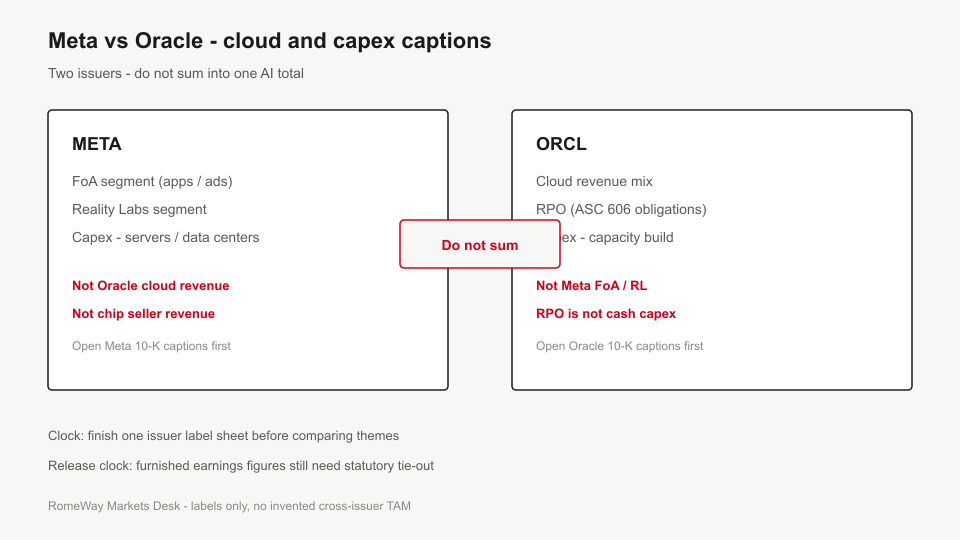
- During the annual read: open each issuer’s 10-K captions before narrating “cloud AI.”
- When the release lands: keep furnished earnings language separate from statutory notes — furnished vs filed.
- After you stop the wrong inference: you still have two companies’ statements, not one AI ledger.
Who this page is for
Stay here if you track AI infrastructure through public filings and keep seeing Meta and Oracle collapsed into one spend number. You need a desk map: which caption on which issuer. You will open EDGAR rather than rely on a wire paraphrase.
Takeaway: This URL is for readers who will name issuer + caption before saying “cloud.”
Who should skip
Skip if you want a price target or a ranked pair trade — not here. Skip if you only need the generic buyer-capex vs seller-chip rule — use that page. Skip if you only need RPO definition — use RPO is not. Skip if you need client-meeting language without targets — use B1.
Takeaway: Leave when the job is generic mechanism, client script, or advice.
Out of scope
No model portfolio, no scrape recipe, no claim that Meta reports AWS-style “cloud revenue” as a primary segment, no summing across issuers into an industry TAM. Figures below are tied to named documents; re-open the live filing before relying on any magnitude.
Takeaway: Mechanism + worked captions only.
Clock: two issuers, two readouts
Read Meta and Oracle on separate clocks even in the same earnings week. For each issuer: open the Form 10-K (or current unaudited 10-Q) → locate segment / revenue mix / RPO / capex captions → write the labels → only then compare themes. Cross-issuer “AI total” arithmetic is the failure mode, not a shortcut.
Takeaway: Finish one issuer’s caption map before you compare.
Meta — FoA, Reality Labs, and capex (not Oracle cloud)
Meta’s Form 10-K for the year ended December 31, 2025 reports two reportable segments: Family of Apps (FoA) and Reality Labs (RL). FoA covers the family of apps and advertising services; RL covers virtual and augmented reality related consumer hardware, software, and content. Source: Meta Form 10-K (period ended December 31, 2025) (also mirrored in public republications such as PublicNow’s FY2025 10-K view).
Explicit disclosures in that annual package include large capital expenditures (including principal payments on finance leases) for the year, with discussion of servers, data centers, and network infrastructure, and separate RL investment and revenue discussion. Related disclosure: FoA vs RL cost and expense mix. Not established by Meta’s segment map: an Oracle-style cloud infrastructure revenue line that you can drop into a multi-vendor “cloud AI revenue” sum.
Desk sentence: Meta capex and RL commentary are Meta’s investing and segment objects. They are not Oracle cloud revenue and not chip seller revenue — keep buyer vs seller intact.
Takeaway: Meta = FoA/RL + capex captions; do not relabel them as cloud ARR.
Oracle — cloud revenue, RPO, and capacity capex
Oracle’s Form 10-K for the fiscal year ended May 31, 2026 discusses Oracle Cloud offerings, the rising proportion of cloud revenues relative to total revenues, and the need for capital and operating expenditures to expand data center capacity for OCI growth, including long-term commitments with data center providers and suppliers. Source: Oracle Form 10-K (period ended May 31, 2026).
Oracle’s fiscal 2026 earnings materials also highlight remaining performance obligations (RPO) as a contracted cloud backlog metric and discuss capital investment supporting AI cloud infrastructure. Source example: Oracle Q4 / FY2026 earnings announcement (June 10, 2026). Treat earnings-release magnitudes as release-clock figures until you tie them to the statutory filing path — 8-K beside 10-Q / furnished vs filed when the US Form 8-K path applies.
Explicit: cloud as a revenue mix; RPO as unsatisfied performance obligations; capex as capacity build. Not established: that RPO equals cash already spent on GPUs, or that Meta’s FoA advertising is the same caption as Oracle cloud revenue. RPO hygiene stays on what RPO is not.
Takeaway: Oracle = cloud mix + RPO + capacity capex; do not equate RPO to Meta’s PP&E spend.
Look-alike matrix
| Caption | Issuer home | Common misread |
|---|---|---|
| FoA / RL segment revenue & investment | Meta | Treated as OCI-style cloud revenue |
| Capital expenditures (servers / DCs) | Meta (and others) | Added to Oracle cloud revenue as one AI total |
| Cloud revenue mix | Oracle | Treated as Meta advertising growth |
| RPO | Oracle (ASC 606) | Treated as cash capex or chip purchases |
| Chip seller revenue | Semiconductor issuers | Treated as equal to either buyer’s capex |
Takeaway: Five captions, at least three issuer types — never one summed “AI” cell.
Filing-line navigation
- Open Meta’s latest Form 10-K on EDGAR; find FoA / RL segment discussion and capital expenditure MD&A / cash-flow investing.
- Write labels: segment names, what RL includes, how capex is described (including lease principal if stated).
- Open Oracle’s latest Form 10-K; find cloud revenue mix language and capacity / capex discussion.
- If using an earnings release for RPO or cloud totals, mark the release clock and plan the statutory tie-out.
- Do not add Meta capex to Oracle cloud revenue or RPO.
- For chip spillover, leave this page for capex vs chip revenue.
- Context only: META, ORCL, terminal.
Takeaway: Two EDGAR tabs, two label sheets, zero cross-sum.
Common mistakes
- Calling Meta “cloud revenue” because data-center capex is large. Wrong caption family.
- Reading Oracle RPO as Meta-style PP&E. Seller obligation vs buyer asset spend.
- Summing META capex + ORCL cloud revenue into AI TAM. Cross-issuer arithmetic error.
- Equating RL revenue with AI training demand. RL is a disclosed Meta segment with its own hardware/content scope.
- Stopping at a press table without the 10-K note. Release clock without statutory tie-out.
- Using delayed Desk lasts as proof of either company’s caption. Cited numbers.
Takeaway: Mistakes rename captions or merge issuers.
FAQ
Does Meta report cloud revenue like Oracle?
Meta’s primary reportable split in the cited 10-K is FoA vs RL, not an Oracle-style cloud revenue mix narrative. Do not force the same vocabulary onto both issuers.
Is Oracle RPO the same as Meta capex?
No. RPO is contracted performance obligation; capex is investing cash / PP&E. See RPO is not.
Can I compare both companies’ capex lines?
You can compare each issuer’s investing disclosure on its own terms. You still must not treat either line as the other issuer’s cloud revenue.
Where do chip vendors fit?
On the seller side of capex vs chip revenue — not inside Meta FoA or Oracle RPO.
What if EDGAR HTML is slow?
Use the same Form 10-K via issuer IR PDF or a full-text republication that names the period end, then prefer the SEC URL in your note.
What to do next
- Still mapping captions: stay; keep the matrix on the desk.
- Generic buyer vs seller: capex vs chip revenue.
- RPO only: what RPO is not.
- Client language without targets: explaining AI themes.
- Release week: premarket checklist.
Takeaway: Route by issuer and caption — this page owns the Meta/Oracle split, not advice.