Customer concentration is a seller disclosure about how much reported revenue came from a small set of buyers. It lives in risk factors and in notes such as “Certain Concentrations” or a “Concentration of Revenue” subsection inside a Form 10-K (or the interim update in an unaudited 10-Q). It is not a product SKU line for HBM or GPUs, not hyperscaler remaining performance obligation, and not the buyer’s capital expenditure. When the path works, you can point to the named caption, say whether the percentage is for a direct customer or an estimated indirect customer, and state what product mix the filing does not break out inside that percentage. The look-alike to refuse is treating “Customer A was 22% of revenue” as if it were a verified AI revenue line item.
This page owns concentration hygiene for AI hardware names. Sibling jobs stay elsewhere: product-level memory mapping in how HBM shows up in Micron filings, GPU vs custom ASIC captions in custom ASIC vs GPU revenue, demand layers in where AI demand shows up, buyer spend vs seller chips in hyperscaler capex vs chip revenue, and cloud contract backlog in what hyperscaler RPO is not. Desk surfaces: AI semiconductors theme, sample stock pages NVDA / MU, and delayed Desk board. Form vocabulary: 10-K, 10-Q, SEC EDGAR, Investor.gov.
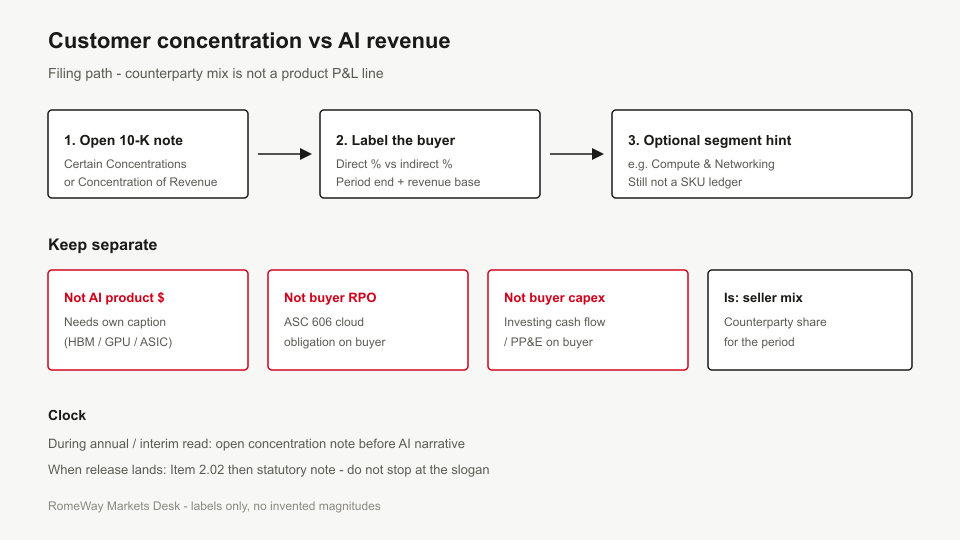
- During the annual read: open the 10-K concentration caption before you narrate “AI demand.”
- When the release lands: if Item 2.02 repeats a customer story, still tie back to the statutory note — see 8-K beside 10-Q.
- After you stop the wrong inference: you still have buyer share, not proof of which SKU or which buyer capex dollar funded the sale.
Who this page is for
Stay here if you trade or advise around AI semiconductor names and keep hearing “Customer X is Y% of revenue” treated as if it were a product ledger. You need a desk sentence you can hand a junior: which filing, which caption, direct vs indirect, what is still unknown. You already open EDGAR and accept that RomeWay quotes are delayed.
Takeaway: This URL is for readers who will name the concentration note before they name an AI thesis.
Who should skip
Skip if you want a ranked list of “must-own” suppliers, a scrape of every customer name, or a price objective — none of that is here. Skip if your question is only HBM product mapping — use the Micron HBM page. Skip if you are asking whether buyer cloud backlog equals chip sales — use RPO is not and capex vs chip revenue. Skip if you only need the premarket document order — use the premarket checklist.
Takeaway: Leave when the job is product mix, cloud RPO, or earnings-week sequencing.
Out of scope
This page does not invent unnamed customer identities, does not sum concentration percentages into an “AI TAM,” does not scrape EDGAR programmatically, and does not assign ratings. It does not claim that every chip sale to a hyperscaler is disclosed as AI revenue. Empty cells on stock pages stay empty per stock-page boundaries.
Takeaway: One intent: concentration caption hygiene versus AI revenue slogans.
Clock: when concentration is the readout
Concentration is usually a during the annual (or quarterly) filing read problem, not a tape-second problem. The healthy sequence is: open the Form 10-K → find Business or MD&A language that points to concentrations → open the note titled along the lines of Certain Concentrations or Concentration of Revenue → record whether percentages are labeled direct, indirect, or estimated → only then ask whether segment commentary (for example Compute & Networking) narrows the product family. Trouble starts when a wire or slide says “AI demand” and the reader never opens that note.
If the event is live earnings, switch clocks: Item 2.02 first (often furnished), then the unaudited 10-Q when available — same ladder as furnished vs filed. Concentration percentages in a press table still inherit the statutory definitions from the periodic report that owns the note.
Takeaway: Annual/interim note clock first; release clock second; slogan clock never substitutes for either.
What a concentration caption actually measures
Under common US issuer practice, a customer concentration disclosure answers: for the reported period, what share of consolidated revenue (or a stated base) came from one customer or a stated group of customers. It is a counterparty-mix fact. It does not, by itself, allocate that share across HBM, discrete GPUs, networking ASICs, or legacy products unless the filing says so in the same sentence or an adjacent segment discussion.
Two legal states to keep apart:
- Named percentage in the statutory filing — the 10-K or 10-Q note (or a risk-factor sentence that points to that note).
- Narrative AI demand language — MD&A, earnings slides, or press commentary that may discuss end markets without restating the concentration math.
Observable result when the path works: you can quote the caption, the fiscal period end, and whether the issuer labeled the customer as direct or indirect. You still cannot invent a product P&L inside that percentage.
Takeaway: Concentration = buyer share of seller revenue for a period, not an AI SKU ledger.
Worked examples: Micron and NVIDIA Form 10-K language
These examples demonstrate the method. They are not recommendations. Periods and percentages are as stated in the cited filings; always re-open the live document before relying on a figure.
Micron — top-ten share, not an HBM line
Micron’s Form 10-K for the fiscal year ended September 3, 2026 states that in each of the last three years, approximately one-half of total revenue was from its top ten customers, and points readers to the consolidated financial statement note on Certain Concentrations (Note 21 in that filing). Source: Micron Form 10-K (period ended September 3, 2026) on EDGAR. Earlier annual reports use the same “approximately one-half / top ten” framing and a Certain Concentrations cross-reference (note numbers can change by year).
Explicit disclosure level: top-ten revenue share. Related disclosure: business-unit and end-market commentary elsewhere in the same 10-K (including data-center / HBM discussion in other sections). Analytical inference you must label as inference: that any single percentage of the top-ten pool is HBM. The concentration sentence does not mint that product split. For product-path reading, stay on how HBM shows up in Micron filings.
NVIDIA — direct vs indirect customers
NVIDIA’s Form 10-K for the fiscal year ended January 25, 2026 separates direct customers (who purchase from NVIDIA) from indirect customers (who purchase through direct customers). For fiscal 2026 it reports that sales to one direct customer represented 22% of total revenue and sales to another direct customer represented 14% of total revenue, primarily attributable to the Compute & Networking segment. It also states that some indirect customers individually represent 10% or more of revenue and that indirect figures involve estimation. Source: NVIDIA Form 10-K (period ended January 25, 2026) on EDGAR (mirrored text also appears in public republications such as PublicNow’s FY2026 10-K view when EDGAR HTML is hard to load).
Explicit: named percentage shares for direct customers; segment attribution primarily to Compute & Networking. Related: risk language that revenue is concentrated among a limited number of direct and indirect customers. Not established by the concentration block alone: a single SKU’s revenue, the buyer’s cloud RPO, or the buyer’s investing cash outlay for servers.
Takeaway: Name the filing period and the direct/indirect label before you narrate AI product demand.
Look-alike matrix: keep these four apart
| Caption / object | What it measures | Common misread |
|---|---|---|
| Customer concentration % | Share of seller revenue from one customer or a stated group for the period | Treated as a verified AI product revenue line |
| Segment revenue (e.g. Compute & Networking) | Internal reporting unit total | Treated as equal to one customer’s concentration % |
| Hyperscaler RPO | Unsatisfied cloud service obligations under ASC 606 | Treated as chip purchases from a named supplier |
| Buyer capex / investing cash flow | Cash outlays for PP&E and related investing activity | Treated as equal to seller concentration % |
Defeat the look-alike in one sentence a desk editor can reuse: concentration is a seller counterparty mix fact; AI product revenue, if disclosed at all, needs its own caption; buyer RPO and buyer capex live on the buyer’s statements — see RPO and capex vs chips.
Takeaway: Four objects, four documents — do not collapse them because all sound like “AI demand.”
Filing-line navigation (no scrape recipe)
- Open the issuer’s latest Form 10-K on EDGAR (or the current unaudited 10-Q if you are on an interim clock).
- Search for captions such as “Certain Concentrations,” “Concentration of Revenue,” “Significant Customers,” or risk-factor language about a limited number of customers.
- Record: fiscal period end; base (total revenue or other); direct vs indirect; whether percentages are estimated; any segment attribution in the same paragraph.
- Open adjacent segment or product discussion only after the concentration facts are written down — do not let MD&A slogans rewrite the note.
- If you arrived from an earnings release, keep furnished Item 2.02 separate from the statutory note per furnished vs filed.
- On RomeWay, load the stock page and delayed board for context only: NVDA, MU, terminal. Empty PE cells stay empty.
Takeaway: Search the note, write the labels, then — and only then — read the AI narrative.
Common mistakes
- Reading a direct-customer % as an AI SKU. Clock error: annual note open, product caption never located. Look-alike: concentration ↔ product revenue.
- Adding several customers’ percentages into “AI share of revenue.” Path error: arithmetic on counterparty mix treated as end-market mix.
- Equating concentration with hyperscaler RPO. Wrong issuer statement. Use the RPO sibling.
- Ignoring indirect-customer estimation language. Treating an estimate as a face-of-statement receivable.
- Stopping at a press-release customer anecdote. Release clock without statutory note tie-out.
- Using delayed Desk last as confirmation of concentration. Quote surface ≠ filing caption (cited numbers).
Takeaway: Each mistake names the wrong object or the wrong clock.
FAQ
Is a 22% direct customer the same as 22% AI revenue?
No. The percentage is share of total revenue from that customer relationship as defined in the filing. Product mix inside that share needs its own disclosure.
Why do issuers separate direct and indirect customers?
Because the buyer of record on the invoice may be a distributor, ODM, OEM, or integrator, while end demand may sit further down the chain. Indirect shares are often estimated.
Does top-ten concentration mean the company only has ten AI buyers?
No. It means those ten accounts were about half of revenue in Micron’s cited formulation — not that other customers are irrelevant or that the half is all one product.
Where do I go if EDGAR HTML will not load?
Retry EDGAR, use the issuer IR PDF if linked from the filing index, or a full-text republication that clearly identifies the same Form 10-K. Prefer the SEC file number and period end on the document you cite.
Does concentration replace segment reporting?
No. Segment totals and customer percentages answer different questions. Do not subtract one from the other unless the filing bridges them.
What to do next
- Still learning the ports: stay on this page; keep the matrix above on the desk.
- Product mix already broken: HBM in Micron or ASIC vs GPU.
- Buyer spend vs seller chips: capex vs chip revenue and RPO.
- Release is live: premarket checklist and 8-K beside 10-Q.
- Workflow / delayed board: Desk terminal, morning routine.
Takeaway: Route by question type — concentration hygiene stays here; product, buyer, and release clocks leave for siblings.