Quick answer
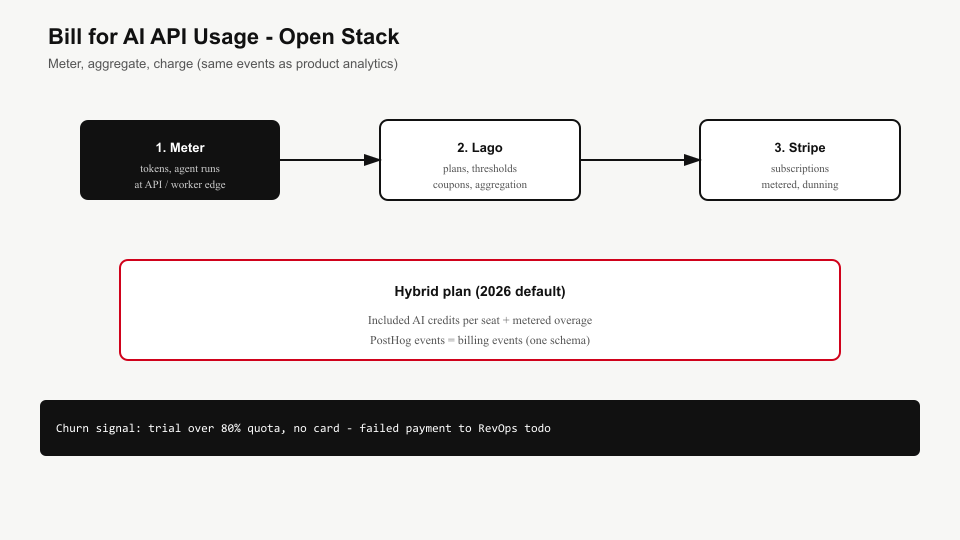
To bill for AI API usage, separate three layers: (1) meter inference or agent actions at the edge, (2) aggregate usage in an open metering plane (e.g. Lago), (3) charge via Stripe with plan tiers and overage rules. Seat-only pricing breaks when one power user burns GPU budget; pure pay-as-you-go scares finance buyers. Hybrid plans with included quotas plus metered overage are the 2026 default for AI SaaS. See the Revenue loop in CorpIM Studio (Lago + Stripe Bridge connectors).
Key takeaways
- Meter at request boundary—tokens, calls, or “agent steps”—not only monthly invoices from OpenAI.
- Open-source metering (Lago) pairs with Stripe for cards and dunning.
- Expose usage in-product; trials with high API use and no card are churn risks, not leads.
- Sync accounting to ERP/Akaunting-class tools for finance close.
- Model cost changes require repricing playbooks—do not silently eat margin.
Who this is for
- AI SaaS founders pricing API or copilot features.
- FinOps leads comparing proprietary billing vs composable stack.
- Engineers implementing usage events alongside product analytics.
Who should skip
- Pure seat-based B2B with no variable inference cost per customer.
- Teams already locked into Zuora/Recurly with working metered lines—migrate only if lock-in hurts.
- Pre-revenue prototypes with <10 design partners—manual invoices suffice until usage patterns stabilize.
Pricing models (pick one primary)
| Model | Pros | Risks | When to pick |
|---|---|---|---|
| Per seat | Simple sales | Heavy users destroy margin | Low variance in AI usage per seat |
| Included quota + overage | Predictable for buyers | Needs clear usage UI | Default for AI SaaS 2026 |
| Pure usage | Aligns with cost | Revenue volatility, CFO fear | Developer APIs, infra products |
| Outcome-based | High value capture | Attribution disputes | Clear measurable outcomes only |
Implementation checklist
Step 1: Define billable units
Choose units customers understand: “AI credits,” “completed reports,” “1k tokens,” or “agent runs.” Align engineering metrics (PostHog events) with billing events so product and finance see the same numbers—see AI feature adoption metrics.
Step 2: Emit usage events
At API gateway or worker completion, emit structured events: tenant_id, feature, units, model_id, timestamp. Buffer and retry; billing loss is worse than analytics loss.
Step 3: Aggregate in Lago (or equivalent)
Map plans, thresholds, and coupons. Lago’s open model fits teams that want to avoid Zuora-class lock-in at seed stage. Map billable metrics to Lago “billable metrics” and attach to subscription plans.
Step 4: Stripe for money movement
Subscriptions, metered line items, failed payment retries. Bridge webhooks back to IM or RevOps todos when cards fail—demo pattern PAY-9912 in CorpIM Revenue loop.
Step 5: Customer-facing usage dashboard
Buyers expect a usage page before enterprise procurement. Show period usage, quota remaining, and overage estimate. Enterprise security reviews often ask for exportable usage logs.
Step 6: Repricing when model costs shift
When OpenAI/Anthropic list prices change or you swap models, run a repricing playbook: margin model → customer comms → grandfathering policy → Lago plan update. Do not absorb 40% cost spikes silently.
Common billing mistakes
| Mistake | Symptom | Fix |
|---|---|---|
| Meter only provider invoice | Per-customer margin unknown | Edge metering per tenant |
| No card on high trial usage | “Lead” burns $500 inference | Quota cap + usage alerts |
| Analytics ≠ billing events | Product and finance argue in board meeting | Single event schema |
| Seat plan for agent product | One customer, 10k agent runs | Hybrid quota + overage |
| Ignore failed payment webhooks | Churn surprise at renewal | RevOps todo on Stripe dunning |
Churn signals in usage data
Patterns worth automating:
- Trial tenant > 80% quota with no payment method.
- Declining weekly API calls after onboarding spike.
- Support tickets about “unexpected usage” before downgrade.
CorpIM Copilot demo answers “which trial accounts are at churn risk?” by joining Lago + Chatwoot context. Wire the same join in production RevOps playbooks under weekly operating rhythm.
CorpIM demo path
- Studio → Revenue loop → subscriptions table.
- Workbench todo Churn risk · Atlas DevTools.
- Run playbook Churn risk save under Guide.
https://www.romewayai.com/corp-im/
FAQ
Should we bill tokens or outcomes?
Tokens align with provider cost and are easy to meter. Outcomes align with customer value but need dispute-proof definitions. Most AI SaaS ship token/credit metering first, then add outcome tiers for premium SKUs.
Lago vs Stripe Billing alone?
Stripe handles payments and can meter usage, but Lago adds plan complexity, coupons, and multi-product metering with an open core. Many teams use Lago for metering logic + Stripe for money movement.
How do usage metrics tie to SOC 2?
Usage logs may contain customer content metadata—treat retention and access controls as part of privacy controls. See SOC 2 checklist for AI SaaS.
When should free tier include AI credits?
Enough for activation (first successful outcome), not enough for production workloads. Cap free inference and alert RevOps when trials approach quota without a card.
Continue the semantic path
Self-host vs API TCO · AI-native Startup OS · Investor updates from live MRR