Quick answer
SOC 2 for AI SaaS adds vendor questions about LLM subprocessors, training data claims, human review of outputs, and logging of agent actions—not a different framework, but heavier evidence. Seed teams should start a lightweight control map before the first enterprise RFP; Series A often needs Type II in progress. Use Probo-class GRC with CI-fed evidence (Trivy/Semgrep → CC7.2). CorpIM Compliance pack demos cap table + SOC 2 gaps + IR; open Compliance tab.
Key takeaways
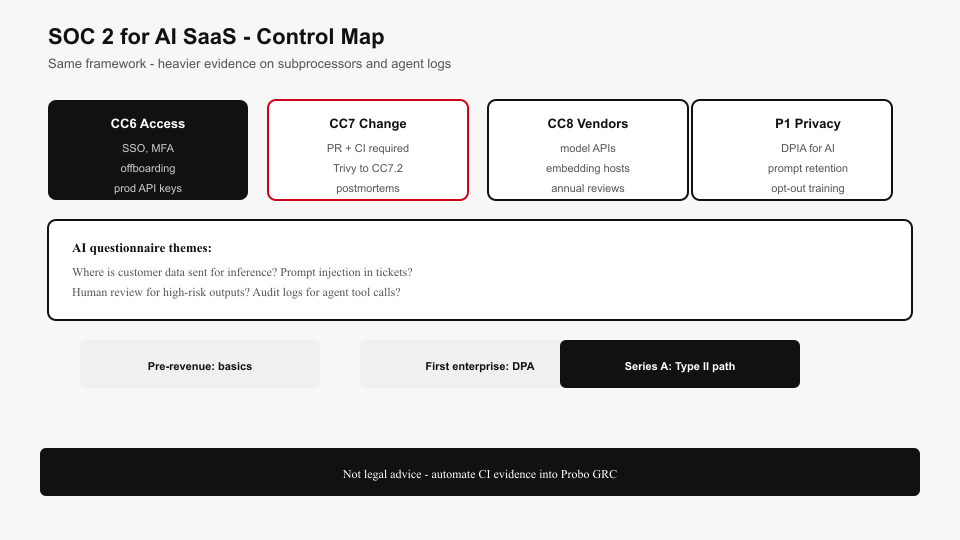
- Inventory subprocessors: model APIs, embedding hosts, analytics, support tools.
- CC6.x access: SSO, MFA, offboarding, least privilege on prod.
- CC7.2 change management: PR + CI required; attach scan results.
- CC8.1 vendor reviews: annual reviews for model and infra vendors.
- Privacy (P1.x): DPIA for AI features processing customer content.
Who this is for
- Seed–Series A AI SaaS founders facing enterprise security questionnaires.
- Ops or eng leads automating evidence from CI instead of Notion screenshots.
- CTOs mapping model vendors into subprocessor lists and DPAs.
Who should skip
- Pre-revenue consumer apps with no B2B pipeline—basic access hygiene only.
- Teams selling only to SMB without security reviews—lightweight questionnaire may suffice.
- Readers needing investor comms only—see investor updates.
When to start
| Stage | Minimum | Why now |
|---|---|---|
| Pre-revenue | Access basics, secrets hygiene, incident runbook | Cheaper to fix habits than retrofit |
| First enterprise pilot | Subprocessor list, DPA template, security questionnaire draft | RFPs arrive before you expect |
| Seed / $500k+ ACV pipeline | Control map, evidence collection, gap remediation plan | Deals stall on “Type II timeline?” |
| Series A diligence | Type II timeline or report in data room | Investors mirror enterprise buyers |
Core control checklist (AI SaaS)
| Control area | What to prove | AI SaaS nuance |
|---|---|---|
| CC6.1 Logical access | SSO, MFA, role-based prod access | Separate prod model API keys per env |
| CC6.6 Offboarding | Revoke Git, cloud, support tools in 24h | Revoke embedding index admin access |
| CC7.2 Change mgmt | PR review + CI on main | Attach Trivy/Semgrep to release evidence |
| CC7.3 Malware / vulns | Container scans on deploy | Scan inference worker images too |
| CC8.1 Vendor mgmt | Annual vendor risk reviews | OpenAI, Anthropic, embedding hosts on list |
| A1.2 Availability | Incident runbooks, status page | Model timeout playbooks in Outline |
| P1.x Privacy | DPIA, retention, deletion | Customer prompts in logs? Retention policy? |
Framework reference: AICPA SOC 2 overview.
AI-specific questionnaire themes
- Where is customer data sent for inference? Retention period?
- Can customers opt out of model training on their data?
- How are prompt injections in tickets handled?
- Human review for high-risk outputs?
- Audit logs for agent tool calls?
- Subprocessor list includes model API and vector DB host?
Overlap with practical AI safety and prompt injection risks.
Evidence automation
Connect CI security scans to GRC so auditors see fresh artifacts—not screenshots in Notion. CorpIM demo: attach Trivy HIGH findings to Probo control CC7.2.
Automate where possible:
- PR merge log → change management evidence
- CI scan JSON → vulnerability control
- Postmortem PDF from incident RCA → availability narrative
- Offboarding ticket closed → access removal proof
Common SOC 2 gaps for AI startups
| Gap | Buyer question | Fix |
|---|---|---|
| No subprocessor list | “Who sees our data for inference?” | Publish list; DPAs on file |
| Prompt logging unclear | “Do you store prompts?” | Retention policy + redaction |
| Manual deploys to prod | “Change control?” | CI-only deploy path |
| No agent audit log | “What did the AI do?” | Tool call traces |
| Stale vendor reviews | “CC8.1 evidence?” | Annual calendar + GRC task |
CorpIM demo path
- Compliance → SOC 2 checklist (CC6.1, CC7.2, CC8.1 gaps).
- Guide → S3 enterprise stage → north-star pipeline.
- Copilot: “What SOC2 evidence is still missing?”
https://www.romewayai.com/corp-im/
FAQ
SOC 2 Type I vs Type II for seed stage?
Type I is point-in-time design; Type II is operating effectiveness over months. Enterprise buyers increasingly want Type II or a clear timeline. Start control map early so Type II observation period is not empty.
Does using OpenAI require a separate AI policy?
You need subprocessor disclosure, data processing terms, and internal policy on what customer content may be sent to inference APIs. Policy + technical controls (redaction, region routing) together.
How do investor updates mention SOC status?
Disclose gaps honestly in risks section—see AI-assisted investor updates. “SOC 2 Type II in progress, CC8.1 vendor reviews scheduled Q4” beats silence.
SOC 2 vs ISO 27001 for AI SaaS?
US enterprise SaaS buyers often ask SOC 2 first. ISO may matter for EU or specific industries. Many seed teams start SOC 2; expand frameworks when pipeline demands.
Continue the semantic path
AI-assisted investor updates · AI-native Startup OS · Observability stack