Quick answer
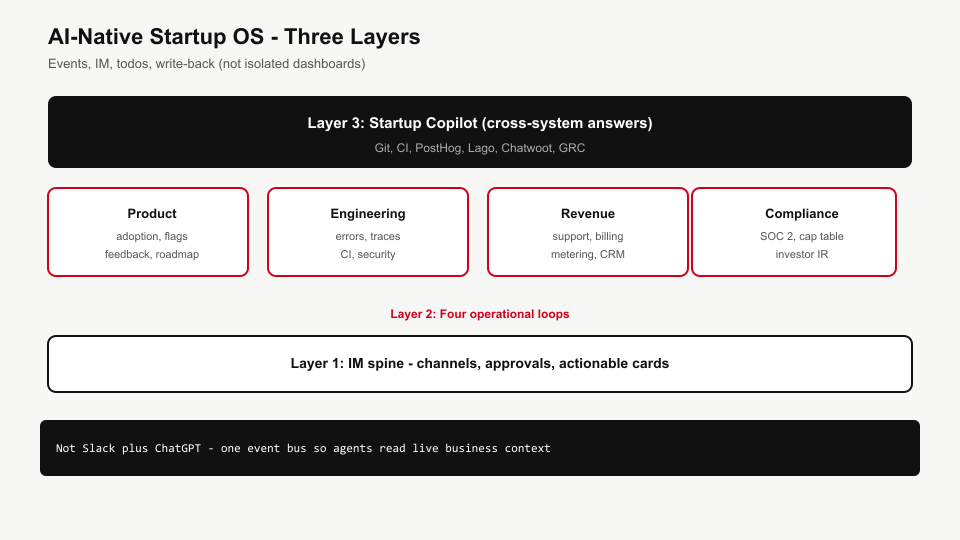
An AI-native Startup OS is not “Slack plus ChatGPT.” It is a single workspace where messaging, approvals, product analytics, billing, error tracking, and compliance share one event bus—so AI agents read live business context instead of pasted screenshots. For AI SaaS companies, the OS must also meter inference usage, gate model rollouts, and tie incidents to support tickets. Explore a demo stack at CorpIM Startup OS: open Guide for stage playbooks, Studio for product/engineering/revenue loops, and Startup Copilot for cross-system answers.
Key takeaways
- Tool sprawl kills AI ROI: agents without CRM, Git, and metrics context hallucinate priorities.
- An AI-native OS wires events → IM → todos → write-back, not isolated dashboards.
- Stage-based operating guides (validate → first revenue → enterprise) beat generic “AI tips.”
- Open-source connectors (PostHog, GlitchTip, Lago, Chatwoot) keep data residency and cost predictable.
- Copilot value = agentic operations, not another chat surface.
Who this is for
- Founders running AI SaaS or AI-heavy B2B products on 5–50 people.
- CTOs tired of Slack + Notion + Sentry + Stripe + “someone’s spreadsheet.”
- RevOps leaders who need churn signals beside support queues.
- Ops leads preparing for first enterprise pilots who need compliance evidence beside engineering metrics.
Who should skip
- Solo hackers with one repo and no customers—start with Git and a metrics tool.
- Enterprises with a mandated Microsoft or Google suite and no integration budget.
- Readers hunting a ranked list of chatbots—see AI copilot vs chatbot instead.
- Teams that only need a customer-facing docs assistant—build RAG on static KB, not a full OS.
Three layers of an AI-native OS
1. Communication and approvals
Enterprise IM patterns (channels, bots, approvals) remain the spine. OA flows—leave, contracts, procurement—should surface as actionable cards in chat, not email detours. Global startups often reject region-locked IM suites; a self-hosted or cloud-hosted hub with open connectors is the neutral layer.
The decision test: if a founder asks “what blocks release this week?” and the answer requires opening five tabs, your communication layer is not connected to execution data.
2. Four operational loops
AI SaaS teams run four loops in parallel:
- Product loop — adoption, retention, feedback, feature flags (e.g. PostHog, Plane, Fider, Unleash).
- Engineering loop — errors, traces, security scans, preview envs (e.g. GlitchTip, SigNoz, CI gates).
- Revenue loop — support, metering, payments, CRM (e.g. Chatwoot, Lago, Stripe).
- Compliance loop — cap table, SOC 2 evidence, investor updates when you sell upmarket.
In the CorpIM Studio demo, these loops share todos and IM channels so a retention dip, a 500 error spike, and a churn-risk account appear in one narrative.
3. Agentic layer
Startup Copilot reads connectors—Git, CI, product analytics, billing, GRC—and answers operational questions: what to ship this week, root cause for production errors, which trials are at churn risk. That is agent architecture applied to company operations, not customer-facing chat alone.
Without the agentic layer, you still have a useful integrated dashboard. With it, cross-system questions become answerable in one prompt instead of a 45-minute tab hunt.
AI-native vs “AI features sprinkled on SaaS”
| AI sprinkle | AI-native OS | So what? |
|---|---|---|
| “Summarize this doc” button | Agent reads ticket + error + deploy context | RCA time drops; fewer wrong ship priorities |
| Separate AI admin panel | Events in IM with approve/remediate actions | Incidents get owners, not Slack noise |
| Monthly manual investor deck | IR draft from live MRR and WAU | Numbers match data room; less founder burnout |
| Model swap in code only | Gradual rollout with flags and monitoring | See gradual rollout guide |
| Seat pricing with no usage meter | Lago + Stripe metering at API edge | See billing for AI API usage |
Operating Guide: stages and playbooks
Tools without rhythm create anxiety. An AI-native OS should ship stage templates (validate, first revenue, repeatable sales, enterprise-ready) with:
- One north-star metric and two guardrails per stage.
- Weekly cadence (daily error scan, Monday retention review, Wednesday release gate).
- Runnable playbooks (first customer, incident, churn save, release, fundraise).
Running S0 rituals at S3 wastes calendar; skipping S1 billing churn checks while chasing enterprise logos burns runway. Pick stage first, then tools—details in weekly operating rhythm.
In CorpIM, pick a stage under Guide, run a playbook checklist, and sync connector events to see the loop end-to-end.
Open-source stack map (demo reference)
Teams self-hosting for cost or compliance often assemble:
- Product: PostHog, Plane, Unleash, Upptime
- Engineering: Gitea, Drone CI, GlitchTip, SigNoz, Outline
- Revenue: Mautic, Chatwoot, Lago, Stripe
- Compliance: Captable-class tools, Probo GRC, IR templates
Pair with self-host vs API TCO when deciding inference vs ops hosting. Pair with open-source observability for LLM apps when your product errors are model timeouts, not only HTTP 500s.
Common mistakes when building an ops stack
| Mistake | Why it fails | Fix |
|---|---|---|
| Buy Copilot before connectors | Model invents MRR and RCA | Wire billing + errors first; Copilot second |
| 15 tools, zero event bus | Humans are the integration layer | IM todos + webhook hub normalize events |
| Same dashboard for all stages | Pre-revenue founders stare at NRR | Stage-filtered Guide (S0–S3) |
| AI feature without adoption metrics | “Users don’t like AI” narrative | Measure prompt-to-success funnel |
| Enterprise SOC deck from memory | Diligence mismatch | SOC 2 checklist + live evidence |
CorpIM demo path (3 steps)
- Guide — Select S1 “first revenue”; review north-star MRR and top-3 todos.
- Studio — Open Revenue loop; trace a support ticket linked to a billing churn signal.
- Startup Copilot — Ask: “Which trial accounts are at churn risk?” and note cited sources.
Live demo: https://www.romewayai.com/corp-im/
FAQ
Is an AI-native Startup OS the same as an ERP?
No. ERPs optimize finance and inventory for mature ops. A Startup OS optimizes cross-loop decisions for small AI SaaS teams: ship vs fix vs sell vs comply—with agents that read live signals.
Do we need self-hosted tools to be “AI-native”?
Not required. The pattern is composable connectors + event hub. Self-host when data residency, margin, or auditor questions favor it; use SaaS when speed wins.
When should we add Startup Copilot vs Dev Agent?
Dev Agent targets code/CI. Startup Copilot targets company ops (metrics, billing, incidents, IR). See copilot vs chatbot for architecture boundaries.
How does this relate to customer-facing AI?
Your product’s inference stack is separate—but billing, observability, and rollout discipline for customer AI should live in the same OS loops as your own ops copilot.
Sources and further reading
- PostHog documentation — product analytics and feature flags
- Lago docs — open-source usage metering
- AICPA SOC 2 overview — trust services criteria context
- Internal cluster: weekly rhythm, investor updates
Continue the semantic path
Next reads: AI copilot vs chatbot for startups, weekly operating rhythm, and buy vs build for stack procurement.